Friday, May 10, 2013

Crab Rangoon

On Good Friday, we flew Air Asia from Hong Kong via Kuala Lumpur (with a night stay) to Yangon. The unexpected brief bonus trip to KL was fun, an odd second world acclimatization to what would follow. Soon enough we found ourselves on a 6am flight from KL's Lower Cost Carrier Terminal (LCCT), definitely the worst airport I've ever been to, to the mysterious land.  With a time zone set an hour and a half behind Hong Kong, we arrived in Yangon still in the early morning. Our initial impression was that this airport was actually pretty decent - Jackie and I exchanged glances wondering if we were in the right place. A crush of excited Burmese people, faced pressed up against the window, awaited us on our exit from the restricted area as we tried to navigate our way to the Air Mandalay offices. Priority #1 was to pick up our flight tickets within the country.

This might be a good time to explain that Myanmar is still not very well connected with the world. One bank has recently begun accepting foreign ATM cards, allowing tourists to withdraw money. Other than that, we have to bring our own US cash, and they have to be pristine.  I was warned multiple times about the authorities rejecting bills with slight marks and visible folds.  Myanmar has done its own thing for so long, closing itself off from foreign investment and intervention, and while the forces of globalization are interminable and making its impact felt, there are still some realities in Burma that present unique challenges to travelers. Domestic airlines in Myanmar have joined the worldwide web, but haven't quite gotten the e-commerce part setup yet. "Online booking" is little more than an internet promise that you will pickup your tickets and pay in cash in Yangon. Policy was to pick up tickets 3 days in advance, but since we had a flight the day after arriving in Burma, I had to make special arrangements to pay everything there. The offices were in the domestic terminal, and so we had to walk out of the international terminal, down a street about 500 yards and into a much dumpier looking building.  Success - they took our cash and gave us our tickets.  Stepping out for a taxi, we were bombarded by offers for rides. It was going to be one of these trips, where an imbalance between the economic wealth of tourists and the local tourism industry created large desperate frenzies of hustlers trying to sell you something. We found a nice taxi driver who spoke decent English. He asked if this was our first trip to Myanmar, told us that his mother was Indian and his father Bamar (the Burmese-speaking majority) and asked us if we wanted to see Aung San Suu Kyi's house. We told him that we greatly admired her but we could see her house another time. Suddenly he stopped on the side of the road. This is her house, he explained pointing to a large gate with a picture of her father, the assassinated General Aung San.
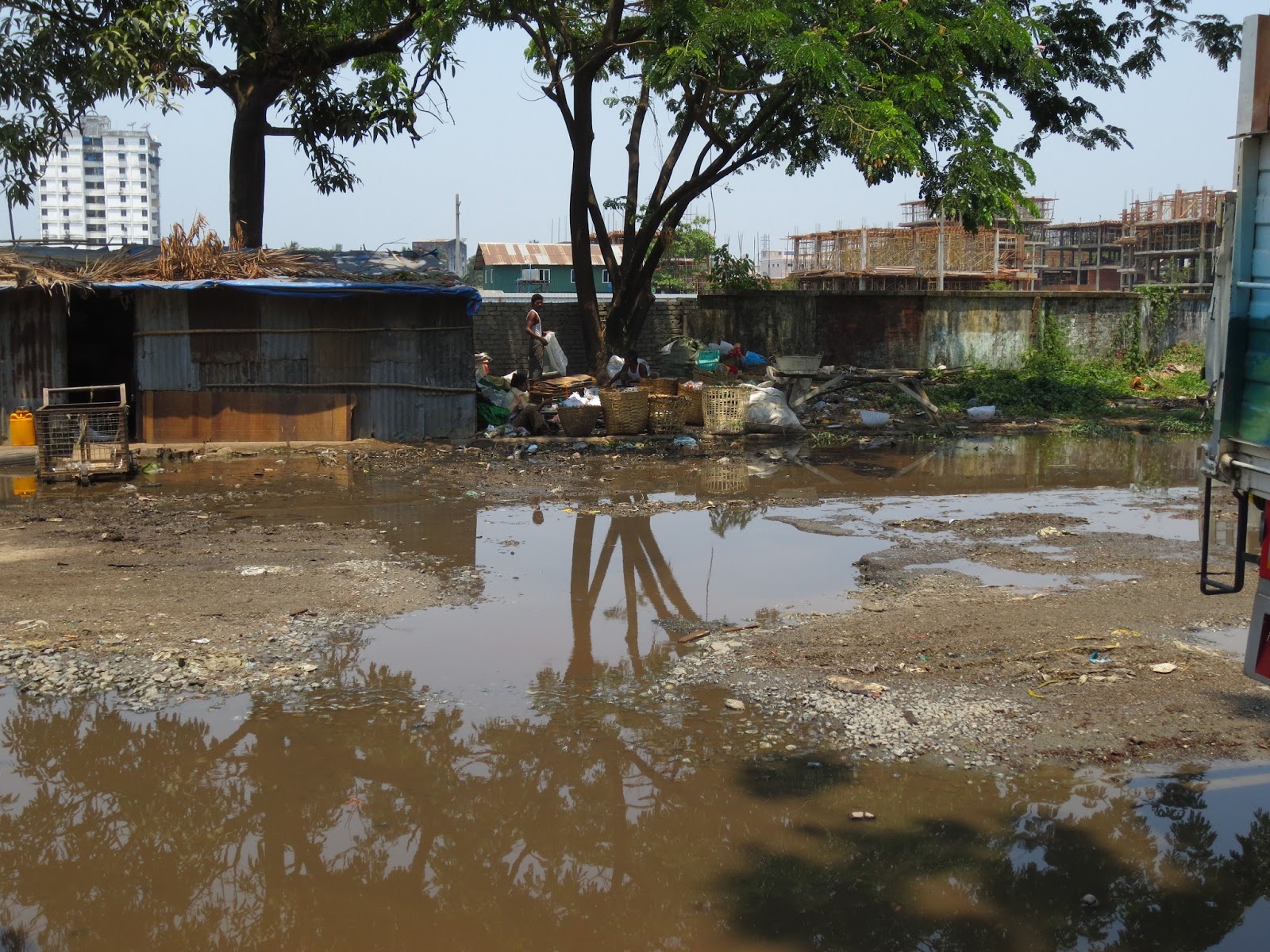
Dirt road near our hotel
We settled in our hotel, way on the east end of Yangon. Despite the intense sun, we decided to set out on foot and see what was in our neighborhood.  Though this area was definitely still part of the capital city, only 40 blocks from downtown, the roads were already unpaved dirt. It took me 10 minutes to realize I needed to get over pointing out visible poverty whenever I saw it. We walked by grease-stained mechanics laboring over truck-sized tires, road sized restaurants with dirty umbrellas and cheap plastic stools and a storefront filled with young women packaging bundles of paper. Like Manhattan, downtown Yangon has numbered streets streets, increasing from east to west (our hotel was on 63rd). Unlike Manhattan, there are few street signs, so we had a difficult time figuring out whether we'd reached the low 50s, where we were told we could find mohinga, the fish soup noodles that defines the region's cuisine. Jackie and I had agreed that we would not eat street food in Burma, because really, our trip was too short to spend it all on a toilet (or squat hole). Yet minutes later after sorting out our various options, we found ourselves basically eating at a Burmese Dai Pai Dong, or open air street restaurant. An hour later at Bogyoke Market, we sampled some glutinous buns which really could have been cooked everywhere. I clenched my stomach, stayed vigilant for any ominous internal bubbling, and hoped for the best.  The boy waiter who served us the mohinga might have been 13, and it took us about 5 tries to understand him asking "egg?" The soup that came was flavorful, but the noodles quite thin and the whole dish generally featured less ingredients than we were used to.

Thus began a slow hypothesis that we'd confirm throughout the week - Burmese food isn't very good.  If you know Southeast Asia even slightly, this should come as a surprise. As I'll get more into later, Burma is a diverse region, variously meshing into India, China, Thailand and Malaysia, all countries of culinary renown. Multicultural hotspots like Malaysia and Singapore tend to be food heavens. If we were expecting Burma to be the same, we were a little forewarned by this passage from The Lonely Planet by local writer Ma Thanegi:
Myanmar cuisine does not use coconut, green chillies or sugar like in Thailand. It is neither as delicate as the steamed dishes of China nor as fiercely hot as Sichuan cuisine. It does not use as many aromatic spices as India.
That's a lot of "nots" associated with Myanmar cuisine. To be fair, I would enjoy the Shan noodles I'd find several times, and the simple salads were fresh and delectable.  But coming from a food-obsessed city like Hong Kong, where people vacation just to eat and you're expected to bring back goodies from trips, it was hard to not be disappointed with the options available.  Even the Indian and Chinese food I had, bland Biryani and almost American-style stir-fry, were unremarkable. When I thought about it more though, high quality food certainly has a lot of unnecessary and expensive garnishes that we shouldn't expect or complain about in Myanmar.

Walking around downtown Yangon, there were far less beautiful white colonial buildings than I had imagined. Wikipedia had told me Yangon had the most of those in Asia.  It took me a while to realize that the decaying, moldy and greying 4 storey apartments in front of me were the colonial buildings, and they had not gone well-maintained since independence. It saddened me to think that, while I'd love to criticize colonialism any chance I got, in at least this one way, Rangoon might have been nicer than modern day Yangon. The city also wasn't as crazy as I expected. Coming from the states, some of the stuff I've seen in China, like a kid throwing a baby bird in the air or women fighting over shopping carts, struck me as crazy. Yangon was pretty ordered - peddlers didn't overly pester us, monks walked around unnoticed and people just went about their ordinary lives. Perhaps the craziest thing I saw was a person with a beaver tail for a head of hair.

We walked all the way to Lucky Seven tea shop, a much ballyhooed part of our Lonely Planet guide. I examined the tiny squat bathroom and decided I was not risking tea, which in hindsight was unfortunate. Jackie had mohinga again and claimed it was better here.

Making our way to Shwedagon Pagoda, we hit up our first photogenic tourist site. Though the pagoda is huge and visible from several main streets, centered at a gigantic traffic circle, the site was so large that walking in, we weren't really able to see it. There are four large stair entrances at each cardinal direction, leading to a complex of temples and shrines centered around the enormous gilded pagoda. Standing there in the late afternoon sun, its glory and dominance did set in and I was awed by a heritage wonder as I'd only been a handful of times before. It was large, it was beautiful, it was ornately decorated, and simultaneously fit in perfectly and didn't fit in at all into this city. It fit in because essentially the city has grown around Shwedagon in the last 1000 years, looking up to and up with the pagoda. It didn't fit in because it was spotless and pure in a country with many scars and problems. We lounged around with other tourists, all of us barefoot, through sunset and into the night and thought about all the kings and queens who had knelt before or contributed gold.

We met up with Chris and Tara later, a married American couple in the Hong Kong ultimate scene who we had semi-coordinated this trip with (leaving them to presume incorrectly that we were also a couple).  We laughed at our mutual American humor as we wandered through the deserted dark streets towards the river. Yangon is not a city of nightlife and it seems most of the inhabitants have a 9 oclock bedtime or a Junta-imposed curfew. The riverfront was also surprisingly barren - I had never been to a major city with a river that hadn't taken advantage of the river. I mean there are cities in New Jersey that have nice river fronts. But here we had reached the river and all we found were some scary stray dogs, some industrial docks, and one restaurant that seemed semi-promising.  We got a few beers there and got kicked out at 11. It was ok, we had a 6am flight to Bagan the next morning anyway.

Thursday, April 18, 2013

Burmese Phase

Aung San Suu Kyi probably entered my consciousness the same way she entered many people not familiar with Burma. I was way too young in 1991 when she won the Nobel Peace Prize in absentia but she came into the mainstream Western news sometime in 2009-2010 up and til her release from house arrest in November 2010.  I must have clicked on an article about her, been confused by what I read and looked her up on Wikipedia, ultimately discovering an absolutely fascinating life story.  I didn't know much about Burma or Myanmar, except that it often showed up on lists with the likes of Iran, North Korea, or Afghanistan, whether the list was toughest places for an American to visit or countries with the worst human rights abuses or least freedom of press.  But part of her was relatable - married an Englishman, lived a scholarly suburban lifestyle as a mom in Oxford.  Then suddenly overnight she became a high profile opposition leader in a large developing country, a shining hope for millions of people and a huge threat for a repressive authoritarian government. The more I read, the more inspired I became by this woman, and I ended up buying her book Freedom for Fear. I read Aung San Suu Kyi describing the history of her country, the political struggles, the fear that keeps government from serving their people and the fear that keeps people from fighting back.

I read much of that book on the D6 bus, coming home from night classes in DC. Burma was far, far, far from a relevant, reachable place in my mind. Even when I moved to Asia, I was interested in seeing Japan, Singapore, Vietnam.  Burma/Myanmar still seemed far, difficult, a place that a young American boy really shouldn't go. It was talking with friends much more well-traveled than me that I realized these notions of "inaccessible" places were nothing more than self-imposed notions. One of my friends here visited Myanmar in 1996 - another one watched his Pittsburgh Steelers win the Super Bowl in the early hours in a hotel in central Myanmar.  And then suddenly sweeping changes happened to the government in Myanmar and everyone started going. Between the time I planned my trip and actually went, a half dozen people I knew made the same trip.

Even so, I had no idea what to expect.

Sunday, February 24, 2013

Sustainability

So I work in "Sustainability" now.  I put that word in quotes because it didn't take long while working in this industry to realize that many of my peers hate the "S-word" and consider it a misleading buzzword. It also didn't take me too long to realize that many of my coworkers doing the same job as me might not identify as working in Sustainability.  Also during my short tenure, my team changed its name from Building Physics to Building Sustainability, to capitalize on this buzz.

Here are some quick numbers behind why I wanted to join this field:
-China emitted over 9.7 billion tons of CO2 in 2011
-The US emits over 5.4 billion tons of CO2 in 2011
-The world emitted around 33 billion tons of CO2 in 2011 (all data from EDGAR)
-The UNEP predicts that 44 gigatons of CO2 by 2020 will lead to our world increasing by 2 degrees celsius from a pre-industrial level. We are currently on target for 58 gigatons.  The 2 degree mark is one that many models predicts will render life on earth unlivable
-The breakdown of end-use energy is approximately 37% industry, 20% transportation, residential and services 36%
-Coal is the most common energy source
-16.1% of the world energy consumption now comes from renewable sources. An additional 2.7% comes from nuclear energy.

However, over 12% of that comes from biofuels in some way and 3.3% comes from Hydropower. Biofuels are technically zero carbon because when they are consumed for electricity, the carbon they emit is equivalent to the carbon they absorbed during their life. However, according to jobsandenergy.com, "The biomass-is-carbon-neutral story line put forward in the early 1990’s has been superseded by more recent science that recognizes that mature, intact forests sequester carbon more effectively than cut-over areas. When a tree’s carbon is released into the atmosphere in a single pulse, it contributes to climate change much more than woodland timber rotting slowly over decades."  For biofuels like corn, they can be used more efficiently as food rather than energy.  Hydropower is zero-carbon, but it's obviously a limited commodity and has potentially devastating environmental issues.  The renewable sources that come with the least baggage seem to be solar (heat and electricity), wind, geothermal (heat and electricity) and perhaps ocean tidal energy. These sources have some flexibility in their placement and create clean energy with minimal adverse impact to environmental or human activity. Still, they do have their own drawbacks and are dependent on resources beyond our control such as the weather and need to be placed in areas where these resources are high. None of these technologies are yet economically competitive with fossil fuel.  Lastly, nuclear energy is essentially zero carbon and very powerful, but obviously has its own dangerous consequences and are being phased out of Japan and Germany.

When I look at this current situation of global energy, I do get scared.  I don't know what will happen in 10 years, 20 years, 50 years. I worry that the planet will not be so enjoyable during my later life, much less for future generations. We really don't know for sure, as this has never before happened in human history, and the globe is so complicated that the best of models need to be taken with an ocean's worth of salt.  Not everyone believes in global warming, and even I'm willing to say there is a slight chance that the climate change we have observed is not anthropogenic. Slight. Even still, as someone who has lived in China, it's very very obvious to me the terrible deleterious effect that air pollution can have, and my experiences in Beijing are a main reason why I decided to enter this field.

To be sure, plenty is being done and plenty of incredible advancement has been made. At my job, there are plenty of developers who want to create energy efficient buildings and no shortage of projects that are pursuing LEED or other Green Building Certificates. The market is going in that direction on its own. There are large scale projects that seek to create more energy efficient districts and cities, built around mass transit, wind corridors and green space. District cooling/heating technology is improving, where local power plants are used to supply power with minimal loss to the district, and the waste heat that is a necessary byproduct of the generation process is used to provide heating (or cooling in a different process). Similarly, combined cogeneration plants are producing electricity more efficiently.  People are working on improving the grid itself, making it more efficient and less susceptible to peaks and troughs of the human behavior cycle. Car companies are working furiously to produce more fuel efficient cars, including electric cars, driven strongly by consumer demand. There are more and more energy efficient appliances. And renewable energy is growing just about everywhere.  Yes I have noticed that the world at large is more energy conscious, less wasteful and more concerned about the environment.

But when I think of what is left to be done, I get even more overwhelmed.  The world is growing, and energy demand is growing even faster. China is already the largest energy user in the world, but its per capita use is about 40% that of the US.  As rural dwellers rapidly move to the cities and the standard of living improves, the per capita energy demand will increase. At a presentation at work, I saw data on Hong Kong's energy situation. In many ways, Hong Kong is a model city with its very efficient public transportation. However buildings use a ton of energy. I noticed that even if all future buildings in the city use 50% less energy than current ones (an impossibly ambitious number), AND all current buildings are retrofitted to use 25% less energy, the entire island would need to be covered in solar panels to reach a zero carbon figure. It made me realize that though we can put a lot of effort and ingenuity into what we do, we can only do so much.  And energy is such a complicated global political issue, with far reaching security, economic and environmental consequences that very often there are multiple competing factions over any new developmental.

So what needs to change? I think first we need to reduce demand. The cleanest energy is the energy you don't use. I believe that we need to change our culture towards energy consumption and that not enough impetus is given in this regard. You can design an energy efficient building with plenty of natural sunlight and natural ventilation, but if people leave the lights on and run the air conditioning all night, it won't be so energy efficient. Energy data can also do wonders - I do strongly believe that if we were all aware every minute of how much energy we were consuming, most of us would change our habits so that we could see those numbers go down. So that would help. But a bigger question is whether we're willing to give up some of our comforts. 60 years ago almost nobody in the tropics had air conditioning - is that something we can or want to go back too? Will we be willing to give up driving?

There needs to be a drastic increase in renewable energy production and perhaps an even more dramatic advancement in renewable technologies.  Geothermal and tidal energy are relatively new and untapped and potentially limitless sources. Solar and wind have been around for a while but are still improving, and our mapping of solar irradiation and wind patterns make it easier to predict the performance of individual units and help plan projects better. Perhaps the most important driver for these technologies is reducing their cost and making them competitive with fossil fuel energy. If solar panels can be produced cheaply (and cleanly) and the price for solar energy drops and the price for fossil fuel energy rises, the free market forces may allow the solar industry to boom. However, though the I think the scarcity of oil and gas will reemerge as a key issue this coming decade, coal is extremely plentiful.  It appears that government policies will need to be around forever to encourage renewable energy investment and use and discourage dirty coal.

Battery technology also really needs to develop. The ability to capture energy and save it for later consumption without too much loss is crucial to a sustainable world.  The question with solar and wind energy is always, "What happens during a cloudy day? What happens when there's no wind?" The ability to save energy for rainy days is a necessary development to parallel the growth of solar technology. It's also a technology that plays an important role in smart grid models (where energy users can store electricity when they aren't using it, then feed it back to the grid when there's a demand) and for electric cars. More efficient transmission is also vital, so that we can carry electricity from windy and sunny areas to less exciting climate zones.

Who are the biggest drivers here? During my time at Arup, I've been trying to figure that out. From this post, it should be obvious that this is an immense undertaking.  Fundamentally, it seems that we are currently most reliant on scientists.  My company doesn't develop any low energy appliances or solar panels, but as these products come out we pay attention and incorporate them into our design. It's still people in the laboratory that need to make magic happen.  Government of course plays its part in funding the engineers and scientists, and creating the appropriate policies to regulate carbon and encourage green growth.  It will have to play an even greater part in auditing buildings and forcing underachievers to get retrofitted, and in creating large scale eco-city projects.

We also need outside the box answers. I think there could be more human-generated energy going into the grid, such as capturing the energy from revolving doors. Office dwellers could carry weights at the bottom of the lift, take it up to their floors and then drop the weights down some sort of slide, where their energy could be captured. Gym goers could have their elliptical and biking work captured and sent into the grid, or at the least to power their machine.  And then there's this bike designed to clean the air in Beijing. Maybe none of this sounds like a lot but it seems like we need to look at every possible opportunity to be nicer to this planet.

The sad thing is that if we succeed - if we successfully pull off the largest international engineering-social-political-technological-environmental transformative effort ever and dramatically alter the course of human behavior, no one will really know. We aren't too sure about the real consequences of all this carbon in the air, of the broad effects of global warming - we even have people who argue against anthropogenic global warming.  The 2 degrees celsius limit is a fairly arbitrary limit that is now being ignored because we're going to blow by it.  But if we pull off a miracle and stop global warming short of this limit, the end result will be a world similar to how it is now.  Nothing will change.  There won't be blue skies and birds chirping every day. The people who questioned the seriousness of climate change will say "I told you nothing would happen" and the people passionate about sustainability can only trust that we've averted something disastrous and that we will continue to do so for generations.  There won't be a "We Saved the World Party", though that would be awesome.  The best we can hope for is approval from future historians. They will either look back on our era as the people who screwed up the earth for them, or the ones who banded together for something very large and changed human history.

Wednesday, January 16, 2013

Guns, Germs and Zeal


Ever since the penny dropped on me sometime during the initial weeks of this blog that perspectives are so influenced by culture, I've tried to really understand different cultures and the way they shape thought. I’ve tried to see the reasoning behind all actions that seem foreign or obviously flawed to me.  Some of these are simpler and more innocuous than others, like understanding why the Irish would bother learning the Irish language or why some Chinese people prefer squat toilets over Western toilets and why Slumdog Millionaire didn’t do well in India.  Others were profound, like realizing that the Chinese government believes its acting for the good of the people in its forceful censorship. Or that many white people feel that they're not more racially discriminated against than minorities. Sometimes trying to understand other beliefs and actions brings me to eat whale in Japan, shark fin in Hong Kong or bulldoze my way into a subway car in Mainland China. I would like to believe that every culture is good in its own merits but surely that's not a free pass to do what you like and chalk it up to culture. But where to draw the line? Is it killing whales? Is it refusing education to girls? Do cockfights have cultural merit? Dogfights? Gladiator fights? How long until we bring up the Nazis?

It’s very sad but the school shooting in Sandy Hook, CT has brought the issue of gun control to the forefront of the national debate.  I was in China without internet access when the event happened and I returned home to see all the tragic news and a newsfeed full of gun control advocacy.  There are articles out since like this
http://www.nytimes.com/2012/12/16/opinion/sunday/kristof-do-we-have-the-courage-to-stop-this.html?_r=0 and http://nymag.com/daily/intelligencer/2012/12/bracing-political-reality-of-gun-control.html.  And even this
Even Nate Silver jumped in on the action with this http://fivethirtyeight.blogs.nytimes.com/2012/12/18/in-gun-ownership-statistics-partisan-divide-is-sharp/?hp where I learned that as an Asian democrat, it’s no surprise that I’m not into guns, because only 5% of that demographic owns guns.  (On a sidenote, this number may be more surprising than it first seems after I think of all the Asian-owned convenience or liquor stores in dodgier DC neighborhoods, some of which the cashiers operate behind bulletproof glass)

The backlash I've seen since the incident is tons and tons of my liberal friends questioning the gun culture and laws in our country and offering up all these articles and proof of the danger of guns.  And living abroad in a place where guns are just about non-existent - well that has only crystallized my belief on the evils of guns. The US is #1 in the world in gun ownership per capita by a large margin, with 88 guns per 100 people.  Serbia is #2 with 58, and China has just under 5.  Not surprisingly, the US also has an absurd homicide rate by firearm for a first world country, though it's considerably better than countries like Honduras and El Salvador and South Africa.  I think when most people see statistics like this, they conclude that the US should follow patterns of gun ownership like the UK, Australia and Japan and voila, far less people die. You simply see examples of other countries doing it right.  And when you look at the history of gun ownership in America, and the whole militia movement and the passing of the 2nd Amendment, and you put it in context with today, it makes very little sense.  Any objective observer would look at the role of guns in America today and think that this is not the best way to go about it.

But there are a lot of non-objective observers in America.  And when you see how passionate some people, like Alex Jones and the NRA, defend their right to own guns, all of my cultural instincts now make me pause and ask why. What goes on in the minds of these people? Why are guns so important to their culture? To me, laws are very limited.  I know that there may be a legislative answer here, but the real problem is not our gun laws but our gun culture, and the only real way to solve our gun problem is to change our gun culture.

Gun-rights advocates really think this is a part of liberty. We are a country founded on liberty, we dedicated an entire statue to it. Don't ask what we need guns for, we just want them and it's not your business to tell us not to.  There are plenty of foods that are terrible for you but they're still legal.  They're fun to shoot and important for hunting.  Other people passionately believe in using them for safety. If you get surrounded by a gang, brandishing out a pistol might be the only way to escape. It might be a way to ward off a burglar. If you trust yourself, you know that you will never use it for ill.

Let's say you grew up with a gun hanging in your house.  You've been taught since young how to handle the gun responsibly, how to shoot, how to keep it safe, and it's just something that's always been in your life. Maybe you like to go hunting, maybe you don't. Maybe you fantasize about shooting down bad guys, maybe you don't.  And maybe you're from a small town, and you see all these people from big cities on TV who don't know how to handle a gun saying that they should take away your guns. That mentality can really put you off.  If you're already mistrustful of government, which you associate with these big city people, to begin with, and are not swayed by their arguments of how they do it in foreign countries, you're going to cling to those guns. I'm not talking about crazies like Alex Jones who dig through history to find appropriate examples to defend his fanatical agendas, but ordinary Americans who just kinda don't think their guns are any of Americans business.  It's not as backwards a mentality as sometimes we on the left make it out to be.

So what can we do? Can we change this culture? Can we convince people that a gunless America is a better America? Maybe not.  Definitely not soon. Definitely not before tens of thousands of lives will be ended by bullets. But do we have to change that culture? Absolutely. And will it make a difference? Absolutely. Just like non-violent protests in the 1960s changed Civil Rights in America forever, open and understanding dialogue can change the gun culture in the US starting in the 2010s.  While the Civil Rights Act was passed in 1964, that was only a law and the movement for racial tolerance and equality is still very much ongoing. Change like that doesn't happen fast, but it clearly does and has happened. To convince Americans that we don't need guns, that fewer guns will result in less senseless tragedy and more general safety, we need to approach this issue in much the same nonviolent way that the civil rights activists did.  We can't attack the NRA as murderers or stereotype these gun people as backwards hicks.  Instead we need to convince them to treat this issue with open eyes.  We need movies that positively portray life in gunless nations, instead of senseless shooting scenes. People can only truly change when they don't feel threatened, and change they can. I no longer use "gay" as a slur, no longer judge mainland Chinese as rude people, and long learned never to joke about rape.  People can change if you let them.

Wednesday, December 26, 2012

A little America in Asia

I think the Philippines was a first for me.  Since moving out to Asia and diving into the ultimate scene, I have met many, many Filipinos. Thanks to the miracle of WhatsApp, one of my Manila acquaintances has become one of my closer friends over here. The Filipino travelers I have met have been universally very fun-loving and nice and I'd very much enjoyed my exposure to Filipino culture abroad.  Thus seeing Manila Spirits on our tournament schedule brought me much excitement and I wondered if I would be entering a metropolis full of awesome fun people.  I can't recall ever having gone into a country for an initial visit having previously met so many of its citizens.

Over two full teams of Hong Kong players went to this tournament and over a dozen were on my Cebu Pacific flight.  Manila is just two hours southeast of Hong Kong and the flights in between are even cheaper than the flight time would indicate. A trip of similar length to Shanghai would cost about $2000 but I knew people who found deals for around $800 HKD to Manila.  The explanations for these price differences could be explained in an economics paper about supply and demand and international economics and suffice to say are outside the scope of this blog.

Passing immigration, we went through a No "Wang Wang" Zone, which no one has as yet properly explained to me.  Since we weren't stopped, I guess none of us Wang Wanged.  Stepping outside of the airport was a reminder that though the flight was so short, the climate change was quite severe. I had heard that the traffic in Manila was bad, but I wasn't prepared for our cab ride from airport to hotel to take over an hour, at 10pm on a Friday.  I had googlemapped the address at work and it showed a driving time of 15 minutes. Immediately I was depressed - how could people live in a city of such poor traffic? Manila does have a rapid transit, as well as jeepneys (more on this later), but I got the impression from talking to residents that getting around was a huge pain that people do need to plan around. It all made me more thankful to be living in Hong Kong.

When we reached our hotel off of Makati Avenue, we discovered a large festival going on immediately in front of our hotel. It turns out that every Friday night a delicious bazaar of food and music takes place right there. We checked into our rooms, Catherine Gainey, Juho and I, and dropped our bags off, briefly debated attending the tournament registration party but as it was already we late, we headed downstairs to check out the bazaar.  Beers at 7eleven were inhumanely cheap to the extent where I exclaimed my amazement that "beer is free in the Philippines." The bazaar had delicious pork belly cut while I bought a kebob and enjoyed a small live band covering American pop songs. American music is evidently very popular in the Philippines and I noted that the first 15 songs I heard were all pop songs that I knew and liked. When we had sat down and started the beer and pork, I laid back and listened to the Filipino singer performing Taylor Swift, I suddenly felt truly happy. The vibes emanating from that square in Manila were so pure and positive and joyous that I couldn't help but get really sappy wonder when I last felt like that. There's something simple and great about live music, travel, the excitement of a frisbee tournament the next day and the company of great friends.

A combination of bad traffic, long distance from the fields and early start times meant that we needed to meet at our rented vans at 6:30am.  Just pass 6:30am, Gainey came screaming into our room asking what time it was. I looked at my phone, which had somehow not charged properly and died overnight. Ah crap. Somehow our teammates hadn't really remembered us either and the vans had left without us. We ran out the hotel and somehow bumped into Michael Hsu, who was staying at another hotel, and we fetched a cab who didn't know where the country club we were going was. Nonetheless we figured that he'd find the directions from his handlers, and after talking in Tagalog and asking "Alabang country club" at least 15 times, we felt pretty good.  Half an hour later we pulled off the highway and our cab drove near a gate, then shouted at the security guard to ask where Alabang Country Club was.  Uh oh.  It seemed this guard didn't know.  He proceeded to ask another 5 people, some of whom pointed him closer and closer to our eventual destination. Apparently the Country Club is a huge gated area and we needed to indicate that we were playing in a tournament there to enter.  Michael Hsu shouted "Derek Ramsey" during these interactions, after the Filipino movie star who is well known to the population for playing ultimate.

We reached the fields with about ten minutes to gametime against the feared Boracay Dragons, a super beach team from the Philippine island of Boracay.  The Dragons play with unbelievable flow and a bit of flair but their game is designed for the beach.  We got some lucky breaks when they moved too fast for the own good and created some silly turnovers.  Though they were the #1 seed in our pool, we beat them 9-7 in one of the biggest upsets of the tournament.  We still ended up finishing last in our pool, getting drubbed by a great Taiwan team and a typically solid Singaporean DiscKnights squad. We won our crossover game over a young local Manila team but had already fallen out of our goal of a top 8 finish.

The vans were a great hire because catching a cab back from the fields were next to impossible.  It was also a particularly exhausting tournament, with brutal sun that cut through my sunscreen, heat we weren't used to expecting in November and stiff competition.  In most overseas the tournament, the consensus would be to have a huge dinner enjoying the local cuisine. In Manila, there was very little clamor of this nature. Though I enjoyed the chicken adobo they served at lunch, there's a reason there are very few Filipino restaurants worldwide.  Even in Manila, the locals didn't seem to eat much Filipino food as there were chain restaurants everywhere. We ended up getting burritos at a Mexican restaurant.  Most of the weekend was spent with my Junk teammates and while we would typically head to a tournament party early because we're so exhausted, this was Manila, home of the party happy Filipino ultimate players, and so we arrived late and left late.  The theme was Mayan Apocalypse and there were some great costumes including Haz Mat suits and inferno demons, but the party may be remembered for the extravagant dragsters that performed.  I had just arrived at the dance floor and just noticed the ladyboy lip synching when s/he left the stage and entered the crowd looking for some helpless soul to "drag." Of course s/he picked me.  All I will say is that, well, sometimes you just gotta go with the flow.  The night ended sometime after 3 and the next day started sometime before 6.

Ok so I wanted mainly to write about how similar the Philippines felt to America, but it seems I have digressed quite a bit.  From the first taxi ride through the city, I was stunned by how the roads seemed of exactly the same construction as the roads back home.  I could have been on I-95, Route 2, Route 66, stuck in traffic anywhere in the lower 48.  The palm trees made me think California especially.  It was the road signs (nearly all solely in English), the types of cars, the fast food chains (with a few unfamiliar faces hello Jollybee's) and the whole feel. It's interesting to think that our entire country could be transported across the ocean with the use of the same factories.  Before this trip, I had seen very little in Asia that reminded me of America.  It's fascinating to me how the Philippines could be an American colony for 40 years and absorb so much, whereas Hong Kong could be a British colony for 150 years (and up to very recently) and still not be very British. The fluency of English spoken by Manila residents was astounding (I didn't meet a single person I couldn't communicate in English with), way surpassing the level in Hong Kong.  I'm at a loss to explain this linguistically, perhaps the previous exposure to Spanish helped, except to say that cultural diffusion is clearly not linear.  I spoke with an American who had been living in Manila for 15 years and she explained that while Filipinos did love American music and culture, their own culture was still very Asian. Perhaps many of the similarities with America are superficial, but there's certainly something there.

The games on Sunday were difficult to say the least. Lincoln was so hungover he couldn't even warm up for our first game, much less play. Still, we had a memorable win by crushing a somewhat injured Beijing Big Brother team, the first time we'd beaten them in recent memory, and finished by beating a different solid Singaporean team. When I got the chance after play to look around, I realized that these fields were really quite beautiful. The large trees outlining the complex were like nothing I'd seen before, a cross between Banyan and Bonsai trees.  When our play was done the place provided a joyful haven to relax in. Two pickup teams played in the tournament final and the team with a large contingent of states-based players won.

This Manila trip was far too short. It was only really in the ride to the airport that I saw the real poverty that I know exists there.  Large shanty towns decked stretches of the shore beside the highway, the likes of which I had only briefly seen in India.  Clearly there is much of the Philippines that isn't like the US that I haven't seen, and I hope I get the chance to in the near future.  Until then, I'd like to write off into the sunset.

Tuesday, December 11, 2012

Twelve Random Thoughts

1) Today is 12/12/12. I started this post at 12:12am actually, and I'm going to wrap it up quickly. This will be the last xy/xy/xy calendar date for quite some time, after a streak of having one every single year for 12 years. Actually starting from 9/9/99, to 01/01/01, 02/02/02...10/10/10, and the epic 11/11/11, there have been a lot of repetitive dates since elementary school. 8/8/88 was the only other one in my lifetime and 2/2/22 will be the next date that's anything close.

2) I like interesting dates, I don't know why. It's probably the number geek in me. Anyway I remember 8/8/08 I was in Beijing for the start of the Olympic Games, 9/9/09 I was at Georgetown and it was my friend Frank's 21st birthday, 3/3/09 (square root day) I had a math test, 10/10/10 I was at Georgetown, and 11/11/11 I had been in Hong Kong for just over a month.

3) The world is supposed to end at 11:11 GMT 12/21/2012, or 7:11pm HK time. Note that I don't believe in the slightest that this day will have any real significance, one look at academic literature on the Mayan calendar dispels any of that.  However, this date has been reverberating in my head for a long time - I think I may have first heard about a 2012 apocalypse before the Y2K. I remember thinking that once 2012 rolls around, we'll still have to wait til almost the end of the year before finding out whether the world does end.  So the fact this date is finally coming has some odd prophetic anticipation about it.

4) I was having a bad day today.  Kinda felt monotonous at work and unmotivated and tired when I finally finished. I was sitting on the couch eating too many French fries watching the Patriots replay long after I had checked to see that they had won, mired in one of those stretches where everything was hard to accomplish.  Then I went downstairs to get laundry and made a stop at the mailbox, where surprise I had mail! Eva & Auntie ad sent me a lovely Christmas card and Maggie had sent me a postcard from Cambodia. I'm not one of those people who randomly have their day made by little acts like this, but this totally made my day. I need to send and receive more snail mail.

5) I ended up cooking a few pounds of spaghetti because I had told my coworkers I would feed them tomorrow.  It was a really interesting juggling act with lots of food and limited kitchen space. At one point I put several plates of ingredients on the ground behind me, and at another I was straining the spaghetti and found that a bit of it hadn't cooked. While trapping the giant pot with my elbow and holding the strainer in my right hand, I took a pair of scissors off the wall and cut the uncooked spaghetti away with my left hand.

6) Sometimes you think you can choose your friends, but you really can't. You can make an effort to be there for someone sure, but friendships are supposed to naturally happen. Some people you might theoretically want to be your friend but these things can't be forced.

7) It's extremely important though to recognize the friends who have chosen you, who think of you when you don't think of them. I think everyone has friends who are way better to you than you are to them. There should be a holiday to correct that imbalance, or you can just read this and go correct it yourself.

8) It's interesting how different family dinners are in Hong Kong and America.  I estimate the average 25 year old urban American who has moved out of the home, basically all of my friends in DC, eat 10-15 family dinners a year.  I estimate the average 25 year old Hong Kong local who lives at home (I haven't met a real local who doesn't) eats 200-300 family dinners a year.  I definitely felt when I came home this past year that I had prioritized friends over family. It's an interesting remark on our culture, but not necessarily a negative one.

9) I've previously noticed that I don't like to go out of my way on the morning commute, even like 3 minutes to get money at the ATM, here in Hong Kong. I don't recall it being such a problem in the states.  I realized today that it's because in those 3 minutes, hundreds of people "pass you." It's this psychological impulse to return to the fast-moving flow that you wouldn't feel if you were say walking alone in a wooded path to work. I'm going to see if there are psychological ways around this because I don't think it's a healthy attitude.

10) I applied for a year-long visa to China and ended up getting a 3 year visa.  Charity from the Chinese government?? There must be some catch.

11) I haven't had a discussion with anyone about the "fiscal cliff" and I couldn't be happier about that.

12) What were the most memorable events of 2012? Syria? Hurricane Sandy? Gangnam Style?  I personally think it was bit of a year for the nerds, with lots of mainstream public attention on the landing of the Curiosity rover on Mars, the atmospheric jump of Felix Boumgartner and the potential discovery of the Higgs Boson.  All are so cool and so geeky. 

Monday, November 5, 2012

The Election from Abroad

The US election is just over a day away right now, but it can feel very far away. Nowadays I'm talking a lot of politics, especially with my western friends, but when you take a step back, it's true that the winner won't change my daily life too much over here. This is actually my second straight election spent abroad, though this time there's a chance I could spend the entire next term as a foreign resident.  And yet this is undoubtedly the election I've followed the most. This election does not need to alter my morning commute or my nighttime news to have an immense impact on my life.

Observing US politics from far away, you notice some embarrassing patterns. For one, the partisanship is unbearable. Campaign staffs monitor every event way closer than they should and look for every opportunity to spin a quote or hand gesture into an attack.  Every single reaction is so blinded by those ideological shades. It's funny that some very fundamental beliefs can align one's ideological leanings to a party line on so many issues, and that's a major reason why our country is so divided.  It starts from what role you believe government should play, and almost everything else stems from there.

This election is mainly about the economy. There are 1000 important issues but that's the one that matters most to most Americans, particularly swing voters. Specifically when you consider the us economy is still the #1 in the world and GDP has bee growing, you realize that the issue is really unemployment. Unemployment has only recently dropped below 8% after hovering close to 10% for much of Obama's term. If you are an Obama supporter, you'll believe that he inherited a mess from the bush administration and that he's prevented a real depression and has led us towards recovery. If you are a Romney supporter you question how deep that bush mess really was and believe that Obama has had plenty of time to fix things and hasn't. A PhD in Economics couldn't definitively tell you otherwise - is the sluggish economy Bush's fault, Obama's fault, Europes fault or inevitable? So your view on this crucial issue boils down to a matter of opinion more than anything else.

Popular national opinion is that we need to find a way to keep more jobs in America. We need to keep our manufacturing industry alive, we need to stand up China and stop sending our jobs and money there. Both Obama and Romney have echoed these sentiments. Nonetheless, both know that the logical and necessary solution may not follow their rhetoric. Romney the businessman knew that exporting jobs to China could help American businesses, and Obama the president hasn't complained about Chinese trade practices until recently. There is much mention in American media about the Chinese currency manipulation practices, but I have never heard someone explain the Chinese perspective. From what I understand, an immediate market correction of The yuan will help American laborers compete with Chinese laborers and reduce the price of American goods in China. It will also increase the real value of Chinese goods in China and Chinese products in the Us. The end result will be the goods many Americans buy will get more expensive, many poor Chinese will see their livelihoods reduced and perhaps starve, and our labor needs will go to Vietnam and the Philippines. But the only people who can vote are American citizens and all they want are jobs and so this rhetoric keeps being repeated. The truth is that our economy has been evolving and will continue to evolve. Maybe our days as a manufacturing and automobile leader are over. Maybe factories will disappear from the American landscape. But that doesn't have to mean our economy will suffer. We can press our advantages in technological innovations, our amazing higher education opportunities, our positive brain gain. These are perhaps the best qualities of America that most Americans just take for granted. But alas we want to be the best at everything, and telling people otherwise is a sure fire way to lose an election.

If being president only meant being in charge of the economy, Romney would be a good choice. The man has a proven track record of running companies well and resurrecting Bain & Company. I do believe that his experience in consulting is relevant to running an economy. But I don't believe running a country is similar to running a business. There are many things the leader of a nation must do that don't help the "bottom line" even indirectly. The President represents the entire country and has to understand the concerns of all sorts of underrepresented and less privileged groups, no mean feat in a country as diverse as the US. The president acts as the face of our nation to the globe. When we elect a president, we show the world the type of upstanding and accomplished people our country is capable of putting out there. 

In the many years Mitt Romney has been a public figure in my zone of awareness, I have never considered him a man who empathized with many different types of people. After examining his life story, he seems to me a person whose life goal was to be important. He went at that initially by going to business school and making a lot of money. After having accrued his fortune, he figured he was important in his circles but could get important on a much larger stage by going into politics. His entire political career has been one of changing political views whenever it becomes suitable, and I tried very hard to find evidence of a single issue that he was genuinely passionate about and had sought office to change, except maybe reducing government inefficiencies.  Perhaps I'm not giving him enough credit for his religious faith and his active involvement in charities, but he doesn't play that up either. This is all in contrast to Obama who seems like a classic bleeding heart liberal, who clearly is passionate about civil rights issues, evident from when he eschewed high paying law firms for community activism and civil rights law after graduation law school. No Obama has not been immune to pandering or ideological waffling either, particularly on foreign policy. But in essence, Romney and Obama represent two very different types of politicians who enter the game for very different reasons.

Of the many gaffes and flaws the media has covered on Romney in this age-old election cycle, the one I disliked the most was his comment on Palestinian economic inferiority to Israel. This was the time he claimed that "culture makes all the difference," implying that the Israeli culture was better suited for making money, and not the time he claimed that Palestinians are not interested in peace.  He made matters worse in my mind by defending his comments, saying he wasn't attacking Palestinian culture, that the same cultural phenomenon happens with US/Mexico.  So much of the last four years of my life has been about understanding different cultures and I'm very aware that the power of culture is strong enough to impact a nation's economy. But I also know how complicated it is to understand a culture different from one own, how so many of the little nuances and constantly evolving traditions cannot be boiled down into a statement like the one the Governor made. And even if you interpret his comment as one praising the Israeli Jewish culture as one that values economic prosperity, you open a whole new set of stereotypes and debates on what a culture should value.  It was a remarkably shocking statement for someone who spent two years living in France, and really makes me question Romney's foreign policy potential.

But he might win.  I believe my man Nate Silver and his model, which is still confidently behind Obama, but even he gives Romney a 14% chance to win. When I look at my Facebook feed and my friends here, I'm very hard pressed to find Republican voters. I have some friends from Georgetown who made themselves well-known in College Republicans, but from a life living in Massachusetts, DC, as a minority college-educated yuppie and now living abroad (where ex-pats are perhaps even more overwhelmingly liberal) has led to run in some very liberal circles. We are the ones turned off by conservatives' unequal attitudes towards women, gay rights, minorities. We see conservatives as narrow-minded, unwilling to help the poor, convinced by the lies that Fox News tells them, clinging to their guns and American-made trucks.  But we don't really know them. So who are these people who are voting for Romney? What is their deal?

To an extent I kind of get them. I try to put myself into a small middle America town. I try to grow up as a lower-middle class white boy in an all-white town, going to church with my community, trying very hard to be a good boy with good manners and a good work ethic. We know about these people in the cities but we don't bother ourselves with them, because they live sinful lives of debauchery, throwing around money, etc. We stick to our simple ways. Or maybe I'm in a former coal town in Pennsylvania, and this used to be a friendly community of factory workers. People would go to work, leave the shift and go en masse to the local pub, have a great time and leave their doors unlocked.  But now the factories are closing, and Hispanics are moving in.  Some are from Dominican Republic, Puerto Rico,  other American cities.  They're nice enough but they don't hang out in the pub with us, they don't embrace our community. They do a lot of their own things and neither of us feel safe.  We're not racist but we want someone more like us in charge, because we want a leader who can understand us, cause after all we're still the majority.

Maybe that's the thought process of some Romney voters. And maybe there are flaws there.  But these are Americans who believe that their parents' America was strong and aren't sure their childrens' America will be. It would take a long time to change these mentalities. So yes, I'm an Asian-American who loves diversity and strongly believe that Obama can connect with way more people than Romney can, but I'm also aware that there are a lot of white voters out there who think they're getting marginalized and wonder if they'll ever see a white president again. I highly doubt any of them are reading this post, but if they are, I want to tell them that they are the next changing demographic. They are the ones we will have to reach out to, for more mutual understanding, else our country is in trouble.  If Romney wins, we will likely have a president who wins 0% of the black vote and 20% of the minority vote.  We will have a country that despite so much progress, will be racially divided over its leader. If Romney wins, the core conservative white base may think that their beliefs have been justified, that they've been right all along and that they don't need to reach out. And wow that would be a dangerous outcome.

So this election affects me a lot here. I have some hope for the United States. I don't think our system and way of life is perfect but I think our methods are working and getting better. I think there are good candidates in our country and lots of ideas being heard and a lot of hard work being done.  I think democracy breathes life into a country and I think the system will get better and better and spread to more and more of the world.

Friday, November 2, 2012

America the Beautiful


Going home is a funny thing. It’s a timeless feeling, the core subject of countless songs, books, poems and the underlying plot of the epic of Odysseus. When you live as an ex-patriate in Hong Kong, a city “home” to countless third culture kids for whom the whole notion of home has been confusingly blended, you get familiarized with hazy definitions of home. You meet people with conflicting nationalities, or those who don’t define themselves at all by their nationality.  I feel lucky that for me, that was not something with which I seriously needed to wrestle. I was born and raised in the Boston area, and until I was 18 I didn’t know what it was like to live anywhere else. 

I returned to the US last Wednesday for the first time as a foreign resident, flying into Washington, DC, a city I called home on and off for five years. Coming back to take part in my brother’s wedding, my trip lasted about a week and a half and allowed me to take a trip down my entire American memory lane. I went through DC, New York and Boston, the only American cities I’d ever lived in. I had kept all three metro cards.

Wednesday evening I got off my plane at Reagan National Airport and strolled to the metro stop, walking past querying visitors with the swagger of a veteran who had plenty of Reagan entrances under his belt. I immediately boarded an incorrect yellow line train. After playing off my mistake as if I had chosen it, I noticed how old the subway system looked.  The plastic interiors of the train, the large concrete halls, the brick tiling of the platform – it all looked so 70’s. And there was space! My instinct when I entered the train was to stand, but as it started moving I realized there were several completely empty seats all around me. Nobody on the car was sharing a seat.

Soon I was at a barbecue restaurant near Maggie’s house, where I was staying, with three of my friends from school. I hadn’t been to a barbecue restaurant in a full year. I got my ribs, I got my coleslaw, I got my beer and before I knew it, I was having conversations about places and people that had literally not crossed my mind in that whole year. We gossiped about professors, former classmates, my friends’ friends whom I had never even met but knew about from conversations past. It was so surreal how fast it all came back.

Within a day I had several nuggets of reverse culture shock. I was crashing on Maggie’s couch on the ground floor, and while changing in the morning, I realized I needed to find a discrete spot away from the windows and peering pedestrians. For a second, I stood inexplicably dumbfounded, as if this ordinary task seemed extremely bizarre. Suddenly I realized – this was never a problem in Hong Kong. 99.5% of Hong Kongers do not live on the ground floor in a place where pedestrians could walk by and see them. I live on the 27th floor and my view is quite secure. I was no longer surrounded by apartments, I was actually in an urban neighborhood of houses. After I was presentable, I went out to the metro and had to wait 5 minutes for the train. 5 minutes is a very standard wait time on the Orange line, even at 9:45am as it were, but I found myself racking my brain to figure out how often I had ever waited this long for a subway train in Hong Kong. I came up with twice: once after watching the Eurocup final in the wee hours and taking a 6am train back, I waited 8 minutes, and another time I think there was a minor delay. Twice. My DC friends were absolutely wowed.

Sitting on a bus in the city, I gazed out at all the passing land. In stark contrast to Hong Kong, there was so much undeveloped green space. There was so much land that wasn’t generating tax, that instead probably took taxpayer money to maintain. There was certainly room for a Hong Kong style mall, an Elements or a Festival Walk, to sprout up, maybe around Foggy Bottom or Farragut West. As a professional in sustainable development now, it was my instinct to imagine Washingtonians operating in these buildings, using an improved infrastructural system. But the former resident in me instinctively bristled. In a sustainable world, isn’t there room for a life like this? Don’t we want to be able to walk down grassy fields by the river under the shade of trees? Don’t we want to be able to sit on a patio out on the sidewalk, drinking coffee and eating sandwiches? Don’t we want to be able to bike down wide streets without fearing for our lives? At that moment, I realized that I loved my life in DC and I loved my life in Hong Kong, despite how incredibly different they were. It is very difficult for me to reconcile these two loves.

I managed to see so many friends over Thursday and Friday, over 20, by meeting for coffee, lunch, dinner and drinks. Trying to sprint through 12 hours of jetlag, it was absolutely exhausting, but I was energized by not having to work and reminders of my youthful exploits in the town. On Saturday morning, I channeled it all. Despite coming home Friday night having closed out Tombs, I woke up at 9:30 and packed all my stuff, then headed into Georgetown for a pregame party before the tailgate. I left that party before 11am so that I could drag all my bags to the tailgate for the start of it. There I ran into another a couple dozen friends, many of whom I had to explain that I had moved to Hong Kong. Just forty minutes later, I finished my beer, said my goodbyes and grabbed my luggage and got another taxi, so that I could make my 12:25 train out of Union Station and attend the wedding rehearsal for my brother.

Suddenly the former classmates surrounding me were replaced by the relatives and family friends, many of whom I hadn’t seen in years.  There were all of DJ’s friends, some of whom I knew well, some of whom I couldn’t remember their names. Due mainly to our enormous extended family, most of the wedding guests were DJ's invitations.  I was whisked from the church where his ceremony would take place, to the hotel nearby where I wouldn’t be staying, back to the church, to dinner in Chinatown before breaking down and demanding solitude on my way to DJ’s Williamsburg condo.

The next morning I woke up really nervous. I didn't really know why, it wasn't my wedding day. I had no idea this was what wedding days felt like. My brother woke up early and seemed relaxed - Catherine had spent the night with her friends, obeying the tradition of the bride and groom not seeing each other until the ceremony proper. I milled about finishing the slideshow I had helped prepare for them, and rehearsing my speech.  DJ's groomsmen arrived between 10 and 11 and we got some food from Smorgasburg and put on our rented suits. They had all been in many weddings that year, including three who had gotten married, and so were used to the drill. It was my first time in a wedding party. A photographer came and snapped our every action. We did our thing then drove across the East River to the wedding. 

It was strange being at the actual wedding and having people come to you, telling you congratulations even though you didn't really do anything except fly 12 time zones and then leave a tailgate early. I haven't been to many weddings at all and certainly never felt like a VIP. We strolled to our spots in the corner of the church and waited, where things seemed to go according to schedule. Little did we know that the limo that was scheduled to pick the girls up was extremely late. Luckily the bridal party was sharp and decided to cut their losses and take a cab, or two because Cat's dress took up two seats. They arrived just on time and looked beautiful and we didn't hear that story til later. The wedding proceeded and I almost felt stage fright having everyone looking at my general direction. I wonder how DJ & Cat felt. I had the rings and kinda fumbled them out of my pocket but got them out and proceeded. Then they said "I do", it was beautiful, we all walked down the aisle and then the families of the bride and groom all lined up for handshakes. I let out a sigh of relief that my duties were over, before I realized that I was in the family of the groom. So I stood side to side with my dad and shook hands with people I knew, people I knew I knew but didn't actually know, people I didn't know if I knew, and a handful of people I knew I didn't know.  The whole time was picture time, and it was quite fulfilling and exhilarating when people lined out and the din quieted and we filed into a limo. We popped some champagne, took some photos, pumped up some jams, and almost got killed when the driver took a wrong turn just before we reached our Brooklyn reception site.  We sat in terror as the limo awkwardly did a 15 point turn in traffic to right itself.

The reception consisted of a lot more photos, some technical laptop setup, and a sprinkling of hors d'oevres and drinks. I was thinking steadily about my speech now and really quite nervous about it. It is probably to date the biggest speech of my life. I probably would not have even volunteered had I not taken public speaking in college and had some confidence going in. In truth, I had thought about the speech for a long time, even before DJ got engaged - I had the whole line about betting that I'd get married before him prepared. When I learned that Cat's mother could not speak English very well, I didn't want to leave her out and so I decided to make my speech bilingual in Mandarin.  This would also allow my Auntie to understand the speech, though the majority of my extended family cannot understand Mandarin.

I was very nervous about that part. I had given a real speech in Chinese and in a practice round with friends in Hong Kong, I was told that my accent was terrible. Which I was aware. I had hoped that by this time my Chinese would have improved more and this would sound fluid. I made up for it by really knowing my speech well and understanding everything that Jenny, my mainland coworker, had helped me pen.  My mischievous cousin Lincoln helped out as well.  Though I was having no trouble accessing the open bar on my own, Lincoln swooped in to "buy" me drinks. He told me it was important to settle my nerves. And again.  When I told him I was good, he brought in my cousin Karen who told me that we hadn't taken a drink together. And so we took a shot. And a double.  It took me to Sunday to realize that Lincoln wasn't trying to settle my nerves, he was really hoping for a train wreck. He subscribed to the belief that wedding speeches can only be memorably great or memorably awful, otherwise they suck. So yes, it would have been hilarious if I went in front of the mike and couldn't say anything intelligible. Maybe.

From the bridal party entrance to the three course dinner to the million people related to us to the Gangnam style dance to the tea ceremony, the evening was a splendid glorious stream of celebration of my brother's and Cat's life.  The whole time I wasn't feeling pure happiness for him, my heart pumped in anticipation for my coming role.  Then my dad spoke. My dad is well known for embarrassing my brother and I, but this time he started with a clever pun, offering picture evidence of how he raised DJ single-handedly. He then went on to make fun of Mom and praise Cat in one graceful swoop, and DJ and I were both spared and moved. His speech was long though, and as noted I had been drinking, and I had to go to the bathroom towards the end of it. So I sprinted to the bathroom, not knowing when my slideshow would be up. When I sprinted back, I saw DJ fumbling on my mac to get the slideshow started. I ran in and took over. However my hands were wet from washing them in the bathroom, and the mousepad didn't work at all. I wiped my hands on the table cloth and tried to maneuver the cursor again, but it didn't work as it had gotten wet. I could feel several hundred eyeballs boring into me, possibly wondering who let this drunk kid on the center floor. I wiped the mousepad with the tablecloth and finally started the Powerpoint. Then I retreated to my table and sipped some water.


The slideshow went over very well though perhaps too long.  I got a little teary not going to lie, it was quite an emotional night.  Then Cat's bridesmaids Hatty and Charlotte gave a joint speech covering some of their humorous exploits as NYU underclassmen and then castmates of the Asian version of Sex & the City. And then it was me. I remember deciding last minute to make fun of myself first, taking the mic from the host, and then opening with "各位好". I then said Mandarin isn't my native language, I know my accent is very bad. That got a surprising number of laughs.  I then went on to say how today was very humbling, how I had bet DJ that I would get married before him, and how despite being cooler, more charming and so much better looking, I have today lost the bet. I then said something simple about how hard it was finding that perfect soulmate in today's high-intensity world, and that while I haven't, I'm so happy DJ has. When I finished the Chinese portion, I actually got an applause. I then repeated the same joke in English, and when people laughed, I thanked them for revealing themselves as non-Mandarin speakers. Then I said how Cat and DJ are both extremely dear to me.  One obviously, is among the people I trust most in the world. Someone whom I feel I can go to for any issue, be it work, homework, leisure or relationships. Someone who has seen me change considerably over the years and whom I’ve seen change. And the other, is my brother.

It was really, really predictable, but the people who didn't know me laughed, and then I went into the mushy stuff, then got off the stage and hugged DJ.  I then took another 3 shots and went table to table.  When I came back and found my cake taken away, I realized I hadn't really eaten much of the great food there, because I'd been so busy going around the hall. I also wasn't that drunk despite what all this sounds, probably because I had spread things out over so many hours. And then the hours caught up, and an unbelievable exhaustion overwhelmed me until I was back in Williamsburg.

I spent another two days in New York sorting out post-wedding logistics and seeing friends. NYC and Hong Kong always get their atmospheres compared, but it amazed me how much more of a walkable city New York was. I would easily rather walk 10 uptown blocks in New York than 4 blocks in Mong Kok or Causeway Bay.  The street food in New York is iconic. The street food in Hong Kong is an obstacle. The city architecture consisted of so much stone, a completely foreign sight in Asia.  NYC still has its flaws, but it might be the best setting in the world to create a story.  Or maybe the stories there are more relatable to me than the stories created in Hong Kong.  Those were some of my random thoughts walking through the city, seeing people I could easily have become.


I took a Bolt Bus home and spent a much needed four days in Newton. I had looked forward to coming home, home home, the placed that raised me, where I learned to walk, talk, multiply, run, jump, read, throw a frisbee, use a computer, play the piano, make friends.  My past was all haphazardly arranged, as if it had not been told that I was coming back and had not bothered to get ready. The crossword book I had written senior year of college was sitting on top of the encyclopedia I had gotten as a Christmas present junior year next to the book on creoles I had read after graduate school next to the fiction book I had started in middle school and never finished. The piano was one we had bought when I was maybe in 8th grade, and the music that I found was partly the classical music my piano teacher taught me in high school, part printed chord sheets for pop songs like Viva la Vida and Love Story, the whole "Piano Man" music sheet, some of DJ's music, some a capella stuff... My room had wall posters from the Red Sox championship runs, now showing disgraced players. The attic, which was enlarged in high school, had the bench where I learned to do decline situps, that used to be in DJ's room. When I turned the TV on I still watched the same channels.  I ran down Beacon Street to the reservoir and around, a route I first completed the summer after junior year of high school.  Bounding down the exact same sidewalks as I had when I was training against hurdlers from St. Mark's and the like, it was bizarre realizing that I was now getting in shape to compete against ultimate players on the other side of the world in two weeks. I had never before run this route with so much sense of life fulfillment. I took a long detour home and maybe it was the suburban American air regenerating me, but I crushed the run. 

The night before I left I asked my mom if I could go over school stuff.  We were actually planning on selling the house, and the emotions of leaving this immense part of me were strong.  When I think about selling the house too long, I think about a couple dozen things, all of which make me want to cry, the most important of which was the uncertainty with where Auntie would go.  The rest of the stuff though I was prepared to deal with.  Nothing in life lasts forever and I was getting to the age where that needed to hit me hard.  Still I wanted to see what of my past was worth salvaging, what I had hidden away from myself. And I was also looking for something. In my junior year blue ringed notebook, I found it. I made a lot of stupid scribbling while taking notes for boring classes (including this Combinatorics class), and most of them don't last long. This was different.

24 year old Cal
30% New York City
20% Boston
12% Hong Kong
10% Washington, DC
5% Chicago
5% San Francisco
5% London
2% Belfast
2% Beijing
9% Other

I guess 20 year old Cal knew 24 year old Cal fairly well, although a 22 year old Cal would have dramatically readjusted those odds.  I think I actually did the same thing as a sophomore in high school, but those may have been gone forever.  I wondered what that person jotting the notes down would think of me now if he met me. I think I would definitely have been surprised by a lot of things. And I think I'd be happy with my life right now. I really hope my current self can look at my 28 year old self and think the same way. 

Leaving home was very, very hard.  Even when my current life is contained in a 400 square foot unit on the other side of the world, filled with all pieces of my life I've acquired since I moved out of that house, it really hurts knowing that this perpetually reliable space may close itself off to me. I wasn't really ready to fly back, I didn't have homecoming or a wedding waiting for me on the other side. But I knew where my place was. If anything the trip back to the US had reassured me that I was doing the right thing by being over in Hong Kong. It's important to know who you are, where you come from, who's important to you. But it's equally important to know what you want to become, what you want to accomplish, and I think my former self, my family and my friends all understand and agree here. Sometimes you need to go home and integrate yourself with yourself.  Other times, you need to create home where your heart is.