Saturday, February 15, 2014

Geographic Analogies

For no reason at all, I am going to do a post examining analogies between geographic entities, where the relationship between two cities for example is compared to the relationship between two other cities. I will look at how the analogy makes sense and where it falls apart. I'm not entirely sure if there's anything to be learned from this exercise, but I think it should be fun. Very often you hear people call a place "The Paris of South America" or the "Harvard of the South," which means nothing except a guarantee that this city is not as beautiful as Paris nor the school as good as Harvard. Sometimes however, comparing two knowns to two unknowns can be very helpful in explaining regional dynamics.

Delhi is to Mumbai as Beijing is to Shanghai


How it works: 
Beijing and New Delhi are the capitals of the two most populous countries in the world, countries that share much in common just due to their innumerable citizenry. Both cities are immense and inland and contain much historical and cultural importance. Shanghai and Mumbai are the largest cities of their respective countries and are the economic capitals, with both on the coast. Shanghai and Mumbai both have stock exchanges, lots of finance and shipping and tall buildings. In contrast, Beijing and Delhi are centers of policy making.  The analogy holds under even historical scrutiny, as Delhi, while ages old, was for many years ruled over by Afghan and Turkic rules and came to prominence under the Turko-Mongol-Persian Mughal Dynasty. Beijing is also as old as time and the capital under Mongol rule during the Yuan Dynasty and under Manchu rule during the Qing.  Shanghai and Mumbai were never capitals of a united China or India, and are much younger cities with their histories more closely tied to colonialism. Shanghai historically spoke Shanghainese, related but different from Mandarin of Beijing, and people of Bombay historically spoke Marathi, related but different from Hindi of Delhi, yet in modern times you can get by with Mandarin in Shanghai and Hindi in Mumbai. The capital cities are also considered to have better universities than their financial city rivals.

How it falls apart: 
For starters, a lot of countries have a big capital city and an even bigger second financial city (Russia, Germany, Spain, US etc.) With China and India being such different countries, it's hard to get too extended with any analogies between them. Delhi has one of India's 3 metro systems and appears to have a better public transportation than Mumbai, which runs on a large but overcrowded rail system. Shanghai is considered the better developed Chinese city and arguably has less traffic issues. Delhi is considered much less of a party city than Mumbai, while Beijing is arguably more of a party city. And I haven't even mentioned how New Delhi is actually the capital city of India. The real flaw in the analogy though is that Mumbai is considered a city with soul and culture and an edge, the home of the thriving Bollywood industry. Please never mistake Shanghai for a city with a soul, Beijing is China's cultural capital, and China's  movie industry is not good enough to have a city associated with it. Also fun fact: Connaught Place is an area in both Delhi and Hong Kong.

United Kingdom is to Europe as Japan is to Asia

How it works: 
Both are island nations off the mainland of their respective continents, together bookmarking the Eurasia landmass. Isolated from the mainland, they both developed cultures quite distinct from the continental countries nearby and still sometimes find difficulty deciding to what extent to align themselves with the larger continent (i.e. UK not adopting the Euro, Japan and its disputes with China). Both countries have had extensive history of war with continental rivals, especially England with France and Spain, and Japan with China and Korea. They have also long been one of the dominant powers of their respective regions, and formed the extensive empires behind the strength of their navies. The English are the dominant ethnic group in the UK and descend from the Anglo-Saxons, who migrated from continental Europe to eventually displace the Celts as rulers of the land. The history of the Japanese people is not as well understood, but it is possible that the ancestors of modern day Japanese people or Wajin, migrated to the islands and displaced the ancestors of the modern day Ainu people. The capitals of these respective nations, Tokyo and London, are two of the world's true alpha cities. Also both the British and the Japanese love tea.

How it falls apart: 
The Imperial histories seem to be one of the biggest similarities between the two nations, but in reality they weren't very similar empires. The British Empire's main holdings were outside of Europe, geographically disparate and extensive and lasted for centuries whereas the Japanese Empire seized the areas nearest them, Korea and Taiwan, before massive expanding throughout East and Southeast Asia for a short period during World War II. Japan also has a much more isolated history, resisting foreign influences for centuries, and as a result is even today objectively more culturally removed from its continental neighbors. It is a very homogenous nation, with the Ainu barely a distinct contemporary ethnic group and with 1.5% of the population foreign citizens. 8.3% of the UK is foreign born, and I think a fleeting glimpse to either nation is suffice to prove that the UK is much more multicultural and diverse than Japan. As such, the essential relationship between the UK and Europe is nothing like the relationship between Japan to Asia. English operates as a lingua franca among Europeans (and the world) among whom it is not uncommon to study at British schools. Japanese is a studied language in Asia and people do study in Japanese universities, but it is more specialized and undertaken primarily among those with a unique interest in Japan. In addition, I haven't gotten to how England, Wales, Scotland & Northern Ireland make up the United Kingdom, and the role of Ireland in all this. And really, who doesn't love tea?

East Germany is to West Germany as North Korea is to South Korea


How it works: 
The end of World War II and the start of the Cold War divided these two nations. One nation became communist (with planned economies and state-owned enterprises and the like), the other capitalist, and decades later the capitalist one was a thriving economic powerhouse with global car brands and the communist one was a struggling starving poor piece of land. A sharp symbolic boundary divided the split nations, with the Berlin Wall in Germany and the Demilitarized Zone in Korea. The splits were dramatic, separating families and creating sharp enmity. The two countries treated each other with suspicion and espionage, though there was always a confusing overhanging cloud of reunion. The golden goal for both situations, reunion could occur peacefully or forcefully. The capitalist countries allied themselves with the western powers, while the communist countries relied on their big strong communist neighbor, Soviet Union and China respectively.  All the countries had fancy names for themselves that took the focus off the split: German Democratic Republic (East), Federal Republic of Germany (West), Democratic People's Republic of Korea (North), and Republic of Korea (South).

How it falls apart:
One is a East-West split and the other is a North-South split.  No just kidding. The main difference is that East Germany was much smaller than West Germany (16 mill to 63 mill in 1990), and largely controlled by the Soviet Union. North Korea is more comparable to South Korea in size (24 million to 50 million present day) and adhere to the principle of self-reliance, Juche, despite all that China helps them with.  East Germany was poorer than West Germany, but it was one of the more successful Eastern Bloc countries and the GDP/capita was over $10,000 USD a year. In comparison, the GDP/capita in North Korea was $1,800 USD/year in 2011. Perhaps the East/West Germany and North/South Korea economic divide were comparable in the late 80s, but now the split is so much wider in the Koreas than it ever was in the Germanies. 

I don't think I need to elaborate too much further on this because I think most people are more familiar with these two situations than perhaps others on this post. But Jon Stewart adds this other analogy: "Dakota, like Korea, has a rather mild south and a north that hates the world."

Many Chinese Cities to US Cities
How it works:

I don't know who did this but somebody bothered to give each Chinese province and most major cities a US equivalent. It's a huge effort worth applauding, but some of the choices are very peculiar. Beijing is labeled LA, probably because of its large population, urban sprawl and smog. It is certainly not an appropriate comparison in terms of its history, culture, weather or transportation. Shanghai is New York, which is the only suitable choice. Some comparisons are pretty nifty. If Beijing is going to be LA, then it makes sense that Tianjin will be San Diego. Nanjing is paired with Philadelphia, and giving their histories as former capitals, that seems fair. Qingdao as Seattle and Dalian as Boston both get seals of approval from me. Hainan is where Chinese people go for their beaches so that'll obviously be Florida. Taipei is Atlanta....maybe because Atlanta was one of the major cities of the Confederate South? I'll run with it. I was very confused about the association of New Orleans, one of the most interesting cities in the US, with Zhanjiang, a town I hadn't even heard of, until I did some research and learned that Zhanjiang was a French colony for 50 years. Wuhan is Chicago and Chengdu is Dallas by virtue of size, and it seems that Chongqing is completely omitted from the map. Inner Mongolia is given the associates of North Dakota, South Dakota and Nebraska, which I'm sure should thrill everyone from all those places. In this map, the old Chinese name for San Francisco (旧金山) seems to be assigned to Hong Kong, and as two cities that I love, that sounds perfect.

My biggest issue from this map is Kunming being labeled as Phoenix (and Yunnan as Arizona, wtf, entirely a southwesterly geographic choice). Yunnan is a mountainous region that's much cooler than even Beijing in the summertime, whereas Arizona is one of the hottest places in America. Kunming is actually a really good match with Denver in my opinion. Their size and importance relative to the country is comparable, they are both at over a mile in altitude, and are home to the hippies of their respective countries. Also, neither Kunming nor Denver were able to participate in Super Bowl 48.


Shenzhen is to Hong Kong as Johor Bahru is to Singapore

How it works: 

Hong Kong and Singapore are both Asian city states  with many similarities including histories as important British colonial ports, centers of major economic might, Chinese populaces and small territories with lots of people. The Chinese and Malaysian cities across the border form their economies primarily around trade with their neighboring city states and contrast starkly with their lower quality of life. JB is primarily a Malay speaking city compared to quadrilingual but English-dominated Singapore, while Mandarin dominates in SZ due to large scale internal Chinese migration compared to two-languages-three-vernaculars but Cantonese-dominated Hong Kong. Both Hong Kong and Singapore draw water and power from their larger neighbors and face issues with immigration from those same countries. Many Hong Kong and Singaporean residents treat SZ and JB as their playgrounds to the north, places to go for a spa or amusement park fling (SZ has Windows of the World, JB has Legoland Malaysia), for a short time to avoid dealing too long with the perceived lower quality service.

How it falls apart: 

Hong Kong is technically part of China, while Singapore are separate sovereign nations. This distinction has important consequences. Hong Kong doesn't keep a standing army, with its waters patrolled by the Chinese navy. Meanwhile, mandatory service is required for all Singaporean men, so that in case of invasion by Malaysia and Indonesia, Singapore won't get completely wiped out. Water supply is also a huge issue. While Hong Kong draws the majority of its water from the Dong river in Guangdong, it sees little problem with this relationship (even though it should since it doesn't totally control the pollution that the river is subjected to). On the other hand, Singapore's treaty to receive raw water from Malaysia expires in 2061, and they are preparing themselves to be self-reliant on water by then. As Malaysia is under no obligation to renew the contract and has previously asked for a hike in prices, Singapore is aggressively pursuing a plan of water conservation, manmade reservoirs, desalination and reclaimed water (branded NEWater). 

Also, Johor Bahru's initial expansion occurred in the mid 1800s under Sultan Abu Bakar and has a distinguished history of its own right. Shenzhen on the contrary can trace its entire modern history to the 1979 establishment of a Special Economic Zone. While both economies are now inexorably tied to their adjacent city-states, JB's came about naturally while SZ's was established explicitly so. SZ has grown exponentially though, developing into one of China's major cities and its port may soon eclipse Hong Kong's in net traffic.


Canada is to the United States as Ireland is to the United Kingdom as New Zealand is to Australia


How it works:

It seems all the major English-speaking countries in the world have an English-speaking neighbor that is much smaller in population and economic weight but while possibly being better places to live. Can you guess which population ratios correspond to which pair of countries - 1:9, 1:14 and 1:4?  Hint: they're in the same order as the section title. 

How it falls apart:
I have never told this analogy without someone getting offended.

Friday, January 10, 2014

SPO: The Redskins debate recontextualized

As a kid learning about the NFL teams, the Washington football team name surprised me. Redskins? That sounds pretty racist - are they sure that's ok? We had so many lessons at school about how the color of your skin doesn't matter, so isn't Redskins exactly what they're teaching us isn't ok to say? But it was the name of an NFL team and no one seemed to be complaining about it, so I just accepted it and watched the games. I thought even less about the Cleveland Indians or the Florida State Seminoles, and the Atlanta Braves tomahawk chant actually seemed cool to me.  The Native American legacy in American sports, or rather that white American assigned legacy to Native Americans, was deeply engrained but totally not well understood by me.

Flash forward to 2013, and inexplicably the Washington Redskins name controversy has seemingly come out of nowhere to be front page debate. Of course, there had always been movements against the names, but these movements only emerged into the mainstream in this past year, without a lightning rod event. In the time being, I've spent a lot of time thinking of racial and historical issues in America and was thus much more opinionated on this matter than when I first encountered it. When I started really diving into opinion pieces though, I began realizing how different this issue is than most modern social issues . Why? Well for starters, as far as I am aware, I have 0 friends who identify as Native American or Indian. Seriously zero. I think I talked to a girl one time who had significant descent from a First Nations tribe in Canada and spoke some Ojibwe, but I don't recall anyone else ever telling me they were significantly descended from Native Americans. The 2010 Census reported that nearly 2% of Americans reported as American Indian or Alaskan Native and nearly 1% did so without checking off any other boxes. From my anecdotes, American Indians are thus WAY underrepresented in the circles I ran in. I mean supposedly there are 2.9 million Native Americans and I've met none of them. Meanwhile I met people who were Mongolian (2.9 million), Icelandic (320,000) and from Wyoming (570,000) in the US and Mauritian (1.3 million) here in HK. In politics, sports and high profile jobs, Native Americans are few and far between, with Sam Bradford (Cherokee, Rams QB), Jacoby Ellsbury (Navajo, Red Sox OF) and Elizabeth Warren (fake, US Senator, MA-D) coming to mind.

Point is, there are not enough Native American voices not just in this debate, but in all mainstream American discussions. I'll argue that current American Indian issues and thought are not well understood by the vast majority of Americans. They teach us quite a bit in school about the early Pilgrims encounters and a lot of the dark devastation that occurred to Native Americans throughout the 16th to 19th century. But we only barely covered the Trail of Tears in AP US History, and I graduated college knowing very little about the modern day life of Native Americans, both on and off the reservations. I think the word "Redskin" is an inherently offensive word that also comes with loaded implicit historical baggage, but I don't feel like I have the proper perspective for my opinion to really matter. I do know that not all Native Americans will agree on this issue, that they generally have bigger issues of social injustice on their mind, and I do think that even if there were no Native Americans left, it still wouldn't be ok to use the word as a team name. However, what I can do is imagine an alternative history where the plight of the Native Americans also occurred in Asia.

If East Asians of the 1400s did not have immunity to the devastating diseases such as smallpox, they very likely would have had catastrophic population loss. Imagine a scenario then where 90%+ of the inhabitants of areas spanning Japan to India perished, and the lands were settled by white Europeans. There'd be pockets of survivors, maybe integrated into white society, maybe a poor marginal minority, and maybe on their own small semi-autonomous communities. I could be living in one of those communities in present-day South China, maybe an hours drive away from the bustling white-majority metropolis of Canton named after a native settlement that had been built on the same site. Imagine then that someone asked me about "Native Asian issues," or the plight of my fellow "Native Asians" in the coastal area of the Philippines who were living in traditional villages and had just been devastated by a strong typhoon. I'd be at a loss for what to say. What would I have in common with the "Native Asians" in the Philippines, or in Vietnam or Korea or those island people in Japan?  We spoke unrelated languages and had far different cultures pre-contact, and what cultural diffusion had made common across the continent might be just a small part of our way of life. To be fair, being minority survivors in a white society would give some sort of group identity, but this would be a newly created one and not an innate historical one.

There are over 20 Native American language families as currently classified.  As an aside, it's a possibility that some of these language families are related, we just don't know the languages well enough to figure it out. Indeed, it would seem unlikely that there were 20 individual intercontinental migrations pre-Columbus. Nonetheless, the Native Americans were/are linguistically diverse, much less culturally and geographically diverse. Perhaps the diversity is not as large as that of Asia, a place of more people and lengthier history of human settlement, but it's not all that far off. It's certainly not so far off that we should be grouping all Native Americans together. Having an individual or group speak for all Native Americans seems a lot more ludicrous in this light, doesn't it?

So I think the ultimate legacy of this Redskins debate is to put Native American issues, so marginalized for so long, more into the forefront of American issues. Even though the discussion concerns sports and not income inequality, cultural transmission or issues more relevant to reservations, and though the issue seems to be fading, it's at the very least made me more aware of the state of modern Native Americans.

Sunday, November 24, 2013

Twenty Five

5^2=25.
I like that equation, there's an odd symmetry about it. It's also my current age and a good one. I feel as if I'm still young, young enough to tell my age to both college students and mid professionals and not alienate either.

Recently is the first time I've felt old. Oddly it was the NBA draft that made me feel old. An ESPN Classic was run on the draft ten years ago, 2003.  As the special went over the Lebron Darko Carmelo Bosh Wade draft order, I remembered everything vividly. I remembered watching Lebron at St Vincent St Mary's in ESPN's first ever televised hs basketball game, then following the regular season with interest as the Cavaliers and Nuggets tanked it out. I remember watching Darko Milicic highlights, reading an ESPN the mag special about him on my flight to France, about how he did 100 push-ups and 200 sit-ups every night and I started doing more on that very trip. I remember watching Wade lead Marquette to the final 4, watching the confident quick point guard who could dunk in traffic pick up a rare tournament triple double. I remember knowing nothing about Bosh because his Georgia Tech team sucked. And of course I remember freshmen Carmelo, Hakim Warrick and Gerry McNamara winning the title.

That was all 10 years ago. The point is, it's a new experience for me, having this memory base that is both so detailed and from so long ago. It's the first time I feel like I could teach a history lesson based off I personal experience. And as a generation now enters high school without memories of 9/11, our experiences are only going to seem more historical from hereon out.

25 seems much different than 24. It seems an age relatable to both college kids and 30 year old professionals, neither too young to have adult conversations nor too old to discuss switching majors. It seems to hold more responsibility - it seems less an age where it is socially acceptable to go explore yourself and go backpacking. It's an age where many people graduate law school, or go to business school, or get their first promotion. Sure there are no set life paths and life is not a race, but life does have a progression, unpredictable though it may be. I have found that as I've aged, priorities, values and responsibilities have all evolved, and thus my whole decision making basis.

When I turned 25 the first thing my mom told me was that she got married at 25. This wasn't news to me, but it was still a jarring fact to internalize. I'm not getting married at 25. I don't think my mom's experiences in the late 70's is a benchmark for me, but part of the challenge I find now is having any benchmark or measuring stick. I'm at a place in my life where I don't quite see too many people in similar situations, with much of my peer group older than me, and so I'm entering uncharted waters largely unsure of where I am, where I can be, where I'm going and where I can go.  It's been a great thrill so far, but I am hoping the path becomes clearer as I venture further.

One of my mindsets when I moved to Hong Kong two years ago was to learn more about the world. I didn't know what that would exactly mean, but I figured it would involve a lot of traveling. I wanted to understand why taxi drivers in DC were often very well educated Africans, why young people get radicalized, how the people away from cities and technology see the world. I don't think I'm close to answering those questions, but I've learned so much more about the world just from absorbing what's around me and being curious. What would have surprised the me that came here two years ago would be how much my perspective has changed. I was very ideal and very proud when I got here, and there's no doubt that in the past 24 months I've become a lot more jaded and had many humbling and sobering (ironically) experiences. I had a conversation with a mirror when I had dinner with my friend who had just graduated Georgetown. I saw in her the exact same attitude and demeanor and optimism for breaking the bounds of society that I had held when I took my diploma without a real good idea of what I would do with it. We have been given so much, are so talented and willing to work so hard - what could possibly go wrong?

Nothing has gone wrong, in the grand scheme. There's just a lot less guarantees, and a lot more time required for real change to occur than I understood two years ago. Or perhaps I understood and just chose to believe it'd be different for me. I remember my mom telling me when I started at Arup that I should expect to stay there for at least two years. My feeling at the time was "don't be too sure" because man two years was a long time. Well it's been two years and I'm still here with no plans to leave. In an industry where buildings routinely take 5-10 years to go from concept to occupancy, 2 years isn't really very long.

To sum up my mindset coming in, and indeed my generation's mindset, this tumblr has really put my experiences in perspective: http://www.waitbutwhy.com/2013/09/why-generation-y-yuppies-are-unhappy.html It explains so much about our generation, the millenials who grew up in a very hopeful world where previous technological and social barriers routinely fell, how we want so much and thus often find ourselves so disappointed. It's very true, this blogpost really did speak to me, even if it did simplify everything into stick figures. It reinforced the lessons that I'd already been learning the hard way, of hard work and humbleness and lack of entitlement. Along the way I've picked up an edge that I would have previously called "jadedness." 

I've seen people get more excited by hope and the call for change, rather than change itself. I work in environmental sustainability, an industry or buzzword that came about entirely to address longterm problems. A direct consequence of this is that the impact of good work isn't easy to conceptualize in a human time frame.  It's hard to get excited about the well-maintained operation of a building or a society that gradually reduces its reliance on fossil fuels. The metrics of success have either not been well-defined or not well measured. Thus it's the rollouts of sexy new plans, schemes for a new technological rollouts, setting of ambitious carbon reduction figures that get the attention rather than the completed actions that are invisibly not hurting the environment (as much).  Two years has shown me how easy it is to talk about the great things we want to achieve, and how promises can be empty even if there is conviction in them when they are made.  This doesn't apply just to the environment. Think about the scenes from Tahrir Square in Cairo from January-February 2011. The mass demonstrations and popular uprising against Mubarak inspired so many all over, and the dramatic tears of joy shed over Mubarak's resignation was a generational moment of raw emotion associated with societal-altering events on par with the fall of the Berlin Wall. But if you had told those ecstatic Egyptians how little things would change and how they'd be right back at it with their next president, I'm not sure if their celebration would instantly deflate. A parallel exists in the United States. So much effort was exerted getting Barack Obama - "Change You Can Believe in" - elected in the President. His victory was equally emotional. Far less emotion has been spent on helping Obama accomplish all that change. We are so much more excited for hope, for the prospect of potential change in the future, than for the victories in a real world which does not clearly define victories. Yes We Can elect Barack Obama, but no we can't eliminate poverty, failures in the educational system, violence, racism, pollution, injustice and disease.

But this blog post shouldn't be a giant typhoon over our collective parade. I think I've made my point that my cynicism has grown since entering the work force. Fundamentally though, I don't think I've changed. I haven't wavered from wanting to make a difference in this world. I believe we can prevent catastrophic global climate change. In fact I don't think there's a choice. In a lesson I learned writing crossword puzzles in college, you have to believe there's a solution in order to find it. And to get this solution, it's going to take understanding a lot of very different but interconnected processes.

So back to understanding how the world works. I really feel that here I've come a long way. I think a lot more now about the lives that we lead and what makes them possible. I think about all the items around me and how they got there, from concept design to the materials behind them to the manufacturing to the shipping. I come from a decidedly not blue collar town, and here in the city of finance I still notice how much the world is driven by working class industry. I see how the factory workers that make leather in Vietnam, T-shirts in Bangladesh and just about everything in Guangdong are pushing the world economy. Through a combination of traveling, observing stories and great podcasting journalism, I understand much better how people are moving from village life, the backbone to their whole lifestyle for generations, to cities. The trip to Burma the spring of this year was great for me as I saw people with less wealth and more measurable problems than I'd ever seen before. I gained an image to reference when I next hear about rice paddies or remote Southeast Asian villages. A growing understanding of this world helps to complement the world of first world cities with which I'm already quite familiar.

Hong Kong is one such first world city, and it's a busy one at that. If it were a superhero, it's kryptonite would be its busyness, disguised as productivity and success. It's a city where everyone spends their short commutes engrossed in their smartphones, an unfortunate consequence of the incredible underground 3G coverage. I am fully aware that this infrastructure is double edged. It enables productivity and communication, but it takes away from the reflective time and makes days go by faster and less meaningfully, and even while I'm aware of this, I find myself trapped by the ease of it all. I play it off as me being extra productive, reading CNN or doing social tasks so that I can be more productive at the office or at home. But I'm not sure if these tasks are really freeing up my day, plus half the time I'm playing CandyCrush. Between a demanding job, a social life, an obsessive athletic hobby, family and a dozen books on my reading list, I'm struggling to figure out how to best organize my day to learn more about the world.
Perhaps I can spin that into the greatest blessing about being 25. I'm at an age where I've actually done some stuff and learned some stuff, but I'm far from being done. My habits are still evolving, my life views well-based but open to change. I have the excitement of not knowing what I'll be able to do, but I've eliminated the fear that I'll completely fall flat on my face on my own.

Friday, September 6, 2013

SPO 2020 Olympics

One of my favorite affairs to blog about are the Summer Olympics, and one of my favorite posts of all times is this one analyzing the possible 2016 host cities http://cal337.blogspot.hk/2009/10/spo-2016-olympics.html. Well it's been four years and the IOC will select the 2020 host city in Buenos Aires on September 7. I've heard absolutely no buzz from the event this time around and I wonder if anyone cares. Well even if they don't, I do and I'm going to blog about it, mostly for the sake of tradition. In case you didn't know, and you probably didn't, the candidate host cities are Istanbul, Madrid and Tokyo.  Candidacies are declared years in advanced (Rome, Baku and Doha were rejected or pulled out) and as you'll see, each candidate city has seen developments since their original bids that will hurt them.

(See also http://cal337.blogspot.hk/2010/12/world-cup-bids.html for World Cup bids)

The factors that I'm interested in are not the same as the factors for IOC voters. I care about how cool the city is, how well prepared its infrastructure is to support the Olympics, how recently the city/country/region has hosted the Games, how novel it would be, how interesting it'd be to attend, how much it would help the city, how much the region loves sports etc. The IOC cares mostly about how much money that city government has used to bribe its voting members.  And to lesser extents infrastructure and government relations and financial windfall.  Here is how I would vote if I were an IOC member, but I'll conclude by telling you who will actually win.

3) Madrid
The Spanish capital bid for the 2012 and 2016 Games as well, where it finished 2nd to Rio de Janeiro. If you clicked on the first link above you'll have noticed that I ranked it last back then as well. I don't want to appear as a Madrid hater, but it's still a less exciting city for me than the other two.  In the last 4 years, the Spanish economy has really tanked, with national unemployment rate exceeding 27%, youth unemployment exceeding 50%, although you wouldn't be able to tell from the €100million transfer fee paid by Real Madrid for Gareth Bale.  The city of Madrid has debts of 7.4 billion, and its bid for the games was dubbed "The Hunger Games" in a Spanish left wing opinion piece. That said, the bid is remarkably frugal, offering a $5 billion Olympic Games. In comparison, some estimates put Beijing's spendings at over $40 billion for the 2008 Games. Previous experience has shown that the Summer Olympics do not make the city money in the short run, and probably don't in the long run either.  Sure, the Olympics bring in construction and speed up infrastructure development and may create jobs in the years leading up to the Games. It'll of course attract swarms of tourists (even after the Games). However, in Spain, it's not clear that more construction is a good thing. Sorry that was a low blow (or a high blow)?  


Madrid does have some world class facilities, including Real Madrid's home stadium Santiago Bernabéu.  It's a great sports country with the world's best football team (the national team). It's already got a great infrastructure and is a world class high speed rail hub, the recent train disaster not withstanding. As a tourist attraction, it's got a lot going for it as a beautiful city that lots of people love to visit (top 5 most visited city in Europe) and it's not an overcrowded behemoth. In terms of recent regional redundancy, Barcelona hosting the 1992 Games is probably largely irrelevant now, but Western Europe held the 2012 Olympics in London. For an Olympics that keeps trying to branch out, keeping the host cities Eurocentric goes against that philosophy. Still the biggest hurdle Madrid faces is the financial crisis. You can't have a city that takes on massive debt to host a sporting event, and you can't have swathes of homeless people bumming around during the Games.  Will the committee members think that the Spanish government can afford the Games? Will they think the Games can be a boon to the beleaguered economy?  Will the 3rd consecutive bid be a charm?

2) Tokyo
Tokyo also bid for the 2016 Games. Repeat bids historically help, as infrastructure gets laid out and plans get to become more detailed and refined. Tokyo is the only previous host in this competition, although the 1964 games are ancient history (Detroit was a candidate city that year, dear God). As the world's biggest city, they probably deserve to be a multiple host city, and they certainly have the infrastructure prepared including some stadiums built for co-hosting the 2002 World Cup. In fact, Tokyo is billing themselves as the safe choice. The Rio Games are behind in their preparation, as was London slightly and Athens majorly in 2004. Tokyo shouldn't have much trouble pulling together the funds and getting a precise, reliable Japanese-style Olympics. The real wild card is the Fukushima disaster, which puts radioactive leaks into the equation. Whether or not scientific evidence can prove that there will be no lingering effects by 2020, the conception out there is decidedly mixed.  Some athletes will be scared of competing in Japan and some committee members will reflect this in their vote. Beijing held the Games in 2008 and Pyeonchang of South Korea will hold the Winter Olympics in 2018, but that's really not too much exposure for the continent holding most of the world's population.

Will committee members put faith in the Japanese to put a reliable, successful Summer Olympics? Will Japanese ingenuity make these Games a very special affair? Or is the fear of radioactivity too much to overcome?

1) Istanbul
If you know me, you know that I like diversity and spreading these sort of events to parts of the world where it has never been before. It's no surprise that I'd rank Istanbul #1. However, I'm not alone with this mindset. The 2008 and 2016 Summer Olympics, 2014 Winter Olympics and 2010, 2014, 2018 and 2022 World Cups are all spreading their events to uncharted territories. Istanbul would be remarkable mainly for bringing the Games to a Muslim-majority nation and a Middle Eastern nation for the first time. Turkey is an up and coming country with some similarities to China in 2001 (when the Beijing bid was won). Most excitingly, placing the Games in Istanbul would have the novelty of spreading events across Europe and Asia.  Istanbul previously bid for the 2000, 2004, 2008 and 2012 Games and is very familiar to committee members. Can the IOC reject Istanbul again??

What's Istanbul's recent Achilles' heel (an ancient Achilles' heel perhaps being Achilles himself)? Well the conflict in Syria probably shouldn't be a factor by 2020, but it's definitely in people's minds right now and refugees from Syria have been spilling over into neighboring Turkey. God forbid there's conflict so far down the road, but I think there is a red line that you can't host the Olympics with a war raging nearby. Istanbul is also under question for its handling of protesters in its public park this past year. It's thus seen as the riskier host city with potentially great intriguing reward. I think it'd be awesome, it's an unbelievably beautiful and special city and would make for a memorable Olympics. Istanbul has hosted major sporting events before, including the 2010 FIBA World Championships, and it'll probably be up for the challenge as much as Rio de Janeiro is.  The Olympics would bring a crowning achievement and recognition to a city with storied history that much of the world needs to relearn. Bring the Games to the Bosphorus or you'll have a lot of people giving up on the IOC cold turkey.

----------------------------------------------------------------------------------------------------------------------

In addition to the host city, the IOC will vote to add one more sport. The main contenders are baseball/softball, squash and wrestling, 2 of which we're talking about re-adding. Wrestling was unjustly removed last year, a shocking victim of the Olympics cutting weight, because apparently some IOC members don't associate wrestling as one of the quintessential Olympic sports. Wrestling is international, with medalists from all sorts of countries including Kazakhstan, India, Japan, Cuba and Mongolia. It's difficult, impressive and athletic as hell, and it's not a bad sport to watch in person or on TV as long as the announcers are competent. Really I don't have much to add. Wrestling is a perfect Olympic sport, I wrestled in high school, and it better be added back to the 2020 Games.

The three cities involved are all awesome. I really believe these Games will be great to watch in any host city and I'd love to attend and eat tapas, kebabs or sushi. Tokyo however is an overwhelming favorite, and even though Madrid is catching up, expect to see the Games in Japan.

Thursday, September 5, 2013

No Lack of Backpacks to Track

So this was what riding on a motorcycle ride felt like. I was sitting behind a Burmese man whose name I couldn't really pronounce, cruising 50mph down a dirt road that doesn't show up on Googlemaps (I checked). Of the new experiences I was hoping to have on this vacation, a Hells Angel ride was not one of them. It would not be the most unexpected new experience though, but we'll get to that later.
We would later pass her

On Easter Sunday, we had taken the early bus from Bagan to Kalaw, which similar to our flight, was predominantly white tourists. We were very much traveling by the seat of our pants - Jackie was leaving Burma much sooner than I and her tight schedule motivated us to fit in as much adventure as we could in as little time as possible. We were hoping to hike from Kalaw to Inle Lake, a 2 or 3 day affair we'd read, and hopefully could start as soon as we hit the ground in Kalaw, despite not having made any bookings.  It was an improvisational type of trip which is the best kind of trip.

When we reached Kalaw, any worry I had at booking a hiking tour was instantly acquiesced by the group of tour promoters swarming our arrival.  Kalaw's main industry clearly was hiking to Inle Lake. We were led to a hostel while trying to figure out scheduling. It was around 4pm and they told us it was too late to embark on the hike - we looked at a bunch of maps of the routes and nothing would work. When I offered to say we could hike fast and sleep on the road, the hostel runner Robin laughed and brought up snakes. Robin suggested hopping on for a motorcycle ride to the last checkpoint, and then doing a 1 day hike and reach Inle by the following evening. So we met our drivers, divided 3 helmets among the 4 of us (guess who didn't get one), "checked in" our larger bags to magically reappear when we reached Inle. I took my valuables with me.

Robin for the record was one of many very very interesting people we'd meet on this leg of the journey. Robin's family were all descended from Punjabi Sikh Indians, but he was 3rd generation Burmese. He spoke Punjabi, Hindi, Burmese, Nepali and English (semi-fluently) and "some of the hill tribe dialects." He had a large family with 3 boys and they were all helping to run the hostel and tour business. They seemed to be doing well but he had never left the country. He said that when he was younger he had really wanted to see the world, but now he says running this hostel, the world comes to him. People from all over the world stay there, and he reads CNN, so he feels he has a pretty good beat on the world. He probably had a point, but I still hope he gets to travel.

So there we are on our motorbikes, cruising down some very rural areas. The landscape was beautiful with low flowing mountains and vegetation that flushed the tan brown and green parts of the color palette. On one occasion I saw what looked like a controlled forest fire. The ride was different than I expected - there were side handles, so I didn't have to clutch the strange old Burmese driver for dear life. With the milder weather of higher altitude and the bike speeding through the breeze, thermal comfort was ideal.

The ride was about an hour and a half, but it didn't feel like real time. I felt suspended along the space time continuum, with unfamiliar scenery flying by me. The motors were loud enough that I felt alone - despite the three people with me, I felt like they couldn't intrude into my moments, that I had all the serenity I needed.

The road twisted and turned and rose through several mountaintops, before the drivers slowed without warning and pulled in front of a monastery.

We met lots of European backpackers on our trip. There was the Dutch girl who only just graduated high school and was backpacking before studying medicine, the Danish couple who had one year left of graduate school, and the German guy who might just have been unemployed. There were lots of similarities to their stories and all of them had been on the road for several months and to several Southeast Asian countries - no backpacker starts in Myanmar. We had only scratched the surface of bizarre characters. At Kalaw we met Frank the French engineer, who had done projects all over the world and been to China 7 times, including months of wandering through Sichuan and Yunnan, and even more unbelievably only knew a few words of Chinese.  He also talked about his Cambodian girlfriend, who he met while he was alone and bored at a bar there. His girlfriend was a waitress at the bar and equally bored - and then he pulled out his ringed hand and told us they were engaged.  They'd only been dating for a year, with much of that time long distance, but he said that her family wants her to get married soon and "some compromises have to be made." I'm not sure if the word compromise has different connotations in French, or really if the concept of marriage is completely different to this guy, but I found the whole story a bit absurd.

Our guide, who arrived with two hikers, was named Sunny and also a cool character. He was also a 3rd generation inhabitant of Myanmar, with his roots in Nepal. He mentioned wanting to visit there sometime though he didn't have a passport and it was very difficult to obtain one, and also spoke about a year working in Bangkok previously. Those two stories didn't make sense to me until he told about his journey to the border and the three stages of bribes he needed to cross the border, on what was a well-established illegal migration route supplying Thailand with many laborers and domestic workers. He had worked at a tailor shop for a Chinese merchant, met a Nepalese-Burmese girl who became his girlfriend and had overall a positive experience in Bangkok, although he did mention being extremely lonely and sad at the start.  He had come back after a year because his father wanted him back, I forget the reason exactly, and started leading these hikes. He looked young but I assumed he was in his mid 20's - I was shocked to learn he was 19. I'm still not used to dealing with people younger than me, particularly people I hire (sounds strange to type that), but I shouldn't have been so surprised. We met so many teenagers and even pre-teens working in the tourism industry that I wonder what the nation-wide high school graduation rate is.  Sunny did graduate from high school, at the age of 16. He had some strong opinions of politics, partially shaped by his experiences in Bangkok and his interactions with tourists. He was critical of Bangkok's culture-less expansion that hadn't particularly helped the poor, and was hopeful that Myanmar would "open up, but not so fast." It would "make the poor people only sad."

And then there was Michael. Michael had grown up in the deep south during the height of segregation (but had made a pact at the age of 6 to not speak with a Southern twang, and didn't). He graduated from UNC in 1968 as an ROTC and was soon piloting planes in the Vietnam War. He worked with Continental Airlines after the war and the company was bought by United after 5 years. He was laid off, but his retirement package was insanely generous, and he's flown free on United since and 10% on most other airlines. 10%, not 10% off. So he's been retired for a while and basically been traveling nonstop. He met his French girlfriend Claire in the Gaza Strip (an underrated single's hotspot) where they were both protesting on behalf of the Free Palestine movement (which he got involved with in part because of the injustice he saw under Jim Crowe laws). They said they met in December, and since they were rather advanced in age I figured they meant December 1979, but no, they meant last December. Michael was full of stories, but I'll remember him for the story he added to our trip.

The monastery was devoid of electricity except for a few solar powered light bulbs, my first encounter with renewable energy used for off grid supply. The shower was hand pumped by a smiling novice monk into a bucket and used behind concrete walls about shoulder high. Lucky we hadn't hiked and didn't need a shower. The rest of the group were exhausted, especially Michael and Claire, and they gritted through the shower/bathe/bucket pour.

Darkness quickly settled and we ha a candlelight dinner with Michael, Claire and Sunny. A cook had driven along for the tour and prepared a very nice simple meal, pleasing to both the palate and the digestive system. Michael and Claire retired early due to their fatiguing hike, and Jackie and I chattered on with Sunny for another hour or two. This was when we learned about his experiences in Bangkok, his political views, his schooling, his family and the surprising fact that he has Facebook (about 1% of Myanmar has access to the internet - even Mongolia has 20%). We met the female guide leading the other group, who was also Nepalese Burmese.  I forget her name but she had been friends with Sunny since childhood and like so much of Asia had gotten interested in Korean dramas. She subsequently studied Korean in university and occasionally guides to Korean tourists. When we finally decided to let Sunny a rest, we strolled into the monastery. Cots had been laid out onto the floor and split among thin curtain dividers. Each divider probably held about eight cots and there were around eight dividers. Since only two small groups were on this hike, Jackie and I had our own divider to ourselves - or so we thought. 

I had just brushed and tiptoed in when I heard some rhythmic heavy breathing. The breathing crescendoed slightly and became distinctly audible, and was soon accompanied by the sound of bodies rolling on the cots. I looked up at Jackie, who was completely still and intently listening. Is this really happening? Is this what I think it is? I whispered to Jackie. She responded with a nod and a smile. Who do you think it is? I asked. As the couple next to us made themselves more known, the paper thin dividers suddenly seemed so inadequate. We heard enough of the male voice to deduce that we were likely a few feet away from Michael, who I guess did have a generous retirement package that allowed him to be a frequent rider. The couple was definitely trying to keep quiet - but not nearly enough. The identities were secured for me when after a rather subdued finale, I heard a woman with a strong French accent say, "I thought you were tired. You found your second wind!" My immediate thoughts were 1) I did not need to know that 2) "second wind" is a really impressive colloquial phrase for a foreign English speaker to know.

I saw Michael outside the monastery at 7am the next morning. Unbelievably, his first words to me were "How did you sleep?"  "Fine. Yourself?" His response, I swear, was nothing more than a knowing smile. I hung my head in amazement and walked away. I resolved never to repeat what Michael and Claire did, and certainly not on Easter Sunday in a Buddhist Monastery.


Friday, July 26, 2013

Lucky Money

I had failed to fully describe the touristy market mob scene that were set up outside the major temples. The merchants were aggressive and span the range spectrum, including ten year olds like Jackie's BFF, whom I took on his word that he was in school but on summer break. They peddled scarves and trinkets and George Orwell's book Burmese Days, which I almost bought for two bucks. ""Four thousand Kyat!" a woman shouted while waving a bundle of necklaces in front of me. "four bucks, lucky money!"

"There's no lucky money. Money is money," I replied. I took a legitimate look at all the wares but they were mostly crap - nothing gets made here anyway in an ancient capital and modern day tourist town. We'd be better off shopping in Inle Lake where there was established culture. I did buy a bamboo box for my mom, shaving nearly half the starting price down. I later learned I didn't bargain nearly hard enough. The starting bids and bartering strategies I had developed in China needed some tweaking here, and it wasn't uncommon to buy a product at a tenth of the starting price.
From South Sudan to central Myanmar
One man outside the Dhammanyangyi Temple was very different. He approached us with a book full of money and asked us where we were from, and instantly we put our guard up. He'd have to go through a stubborn wall to get at our Hong Kong but US but kinda Hong Kong before that origins. But the man then opened us his book and showed us all these bills he had collected from all sorts of currencies - there were British pounds, Japanese yen, a US $2 bill, Indian rupees, Russian ruples, South African Rand. Then there was currency from Mozambique, Rhodesia (former Zimbabwe), Mongolia, South Sudan, Afghanistan and Japanese occupied Burma. I couldn't figure out which bill I was most impressed by. Even more amazingly, he had nothing from Hong Kong. I had already switched to a trip-specific wallet, but Jackie donated a plastic 10HKD bill for his cause. The man didn't try to sell us anything - we had come across an honest good-natured collector.

After the donkey cart trip to our hotel at the tip of New Bagan
You're not supposed to climb like this
, an instant nap and a dive in the pool, I set out for my first bike ride in months. Our hotel rented us two bikes for 1500 Kyat each. "What time do we need to return them?" "Ten." "Ten? What if we're late?" "Actually, no matter. Put here when you get back." My fears of a tourist industry out to milk foreigners for all they were worth we're unfounded. This bike rate would have only gone an hour on Capital Bikeshare. With my camera bumping around loosely in my lower pocket, I jumped on and took those glorious first pedals after months of absence from two wheeled transit. The reddish dirt was soft and hard to ride on, but the dirt roads were better packed and featured only the occasional car or motorcycle. Riding in the temperate heat, so far away from the urbanity that has enveloped my entire life in Asia, without another tourist in sight, was an incredibly liberating feeling. We pulled off the side of the road at the first semi-large stupa we saw, checking out small golden Buddhist statues behind locked doors in complete isolation. We passed by the Bagan Archaeological Museum after closing hours, and another medium sized temple with a small tourist market assembled in front. We were on the road towards Shwesandaw Temple which we heard was the place to go for sunset when we came across another cool looking temple, with a tall round golden spire. We swerved off the road again and dropped off our bikes at the edge of a large empty courtyard. It was a bit eerie standing there alone, with neatly lined square tiles with small square planted saplings strewn across. A large cocktail party could be held here, in the shadow of the grand temple. I glanced back at our abandoned bikes and wondered if we should keep a closer eye on them. A second thought about our isolation and the kindness of the people in this country persuaded me not to.

Maybe Obama was here?
We walked pass a landscaped sign in Burmese, or perhaps Pali, presumably describing the temple. Inside we were surprised to discover a father, mother and young son, purveying over a table with a dozen drawings laid out on the floor. I immediately felt bad for them, thinking that there couldn't be nearly enough traffic here for this family to make money. The father spoke English well and unlocked a door to the rooftop, and told us that when Obama had come to Bagan in November, he had gone to three temples. The other two were the big ones (Ananda was one of them), but this was the third. I've done my googling but I can't verify this fact, nor can I even remember the name of this wayside temple, but at the time it felt very cool walking up the same stairs that the President himself might have walked up. The setting sun gave the stones on the rooftop a very reddish hue, and I currently long for the undisturbed view I saw there. We saw Shwesandaw in the distance, visibly swarming with tourists. I thought for a moment about staying here for sunset - the view was nice and the peace great. But we were in the mood for company and weren't scared by the crowd. I might have done some illegal climbing on the walls, which is sheepishly one of my favorite ruins activity, and I wondered what it'd be like growing up as a kid in these parts, climbing temples instead of trees. The temple I was sitting on was quite marvelous - in any other part of the world, it'd never be this empty. But here in the ocean of temples, it is just a small fish.

Tourists swarming the temple
We ventured back down to the family custodians of this temple, and I had to swallow hard while rebuffing the father's attempts to sell pictures. Our bike ride towards Shwesandaw saw more and more traffic until we arrived in a large bay of parked buses and bikes and horse drawn carriages. A pair of massive Korean buses with correspondingly massive amount of Korean tourists caught my eye. We left our bikes in a pile of other unguarded rentals and ventured past a bustling marketplace. This temple was tall, and the staircase went straight up the middle of the sides like Chichen Itza in Mexico, not swirling up the interior like in previous temples. They got steeper towards the higher levels, and at one point I got stuck behind some struggling elderly French tourists and had time to snap this photo.

French tourists are le tired
We ran into Chris and Tara at the top podium, which was a lovely semisurprise. The sunset itself was a semidisappointment as the hazy orange orb disappeared behind clouds and buses and no one was quite sure when it really set. The international mass of tourists grumbled and descended down the temple steps, carefully, and in the hubbub of souvenir sales and motors starting, we made plans to venture to Be Kind To Animals The Moon.  This ungrammatical capitalized word group is the most popular restaurant as recommended by the Lonely Planet, and we had been captivated by the guidebook's restaurant review and the bizarre name. We definitely had the name right, the drivers knew where we were talking about. Chris and Tara took a horse carriage, and we followed behind on our bikes to downtown Bagan.  Turns out there really isn't a downtown Bagan - there is no quaint village square , green or main street like I had imagined, or even a tourist friendly congregation of restaurants and bars. There weren't even many public lights. There was one strip with a handful of restaurants and an art gallery, and this strip apparently had the name Be Kind to Animals.  The Moon was the name of our restaurant, standing front and center in the little strip, with a sign saying Recommended by Your Guide (Lonely Planet). Be Kind to Animals Yar Pyi stood on the other side of the the dusty dirt road, with a sign saying "Lonely Planet might not talk about us (yet) but lovely people do! Check out their testimonials! The Yar Pyi family say we are the most delicious." That sign did its accomplished goal and tugged at my heart strings. The economic implications of making it into the Lonely Planet, a black box of a process that seemed as likely to be fair as it was to be arbitrary, struck me. But we had talked about the Moon so much that we couldn't change our minds, and off we went to the mainstream tourist restaurant and not the hipster family owned one.  The restaurant was vegetarian, which was fine because I never found good meat in Myanmar period, and interesting dishes like banana pancakes with syrup (more like a crepe), pumpkin curry and chapati made for perhaps the best dinner of our trip.

It was well into the night though when we finished, and a long ride home on unfamiliar roads in total darkness was now unavoidable. Not gonna lie, I was hoping there'd be another horse cabbie we could follow as it was a little daunting at the start to imagine biking on very unfamiliar roads in a very isolated very foreign place. But the directions were simple, there were only a few main roads and our inn was off one of them. As we passed by silent dark temples dimly and eerily lit by sparsely spaced out streetlights, I wondered if this was the environment with which tomb raiders broke into the temples and stole valuables. I had always wondered when the pyramids of Egypt had been robbed - did the same phenomenon occur here?  We turned onto our main road and spent a long time on it - much longer than I remembered going out on, and for a second I wondered if we were terribly terribly lost. Would we have to sleep on the side of the road? Were there Burmese pythons around? My legs were getting tired and my brain was racing towards more and more terrifying consequences. When the Kaday Aung Inn sign appeared, I'm not sure I'd ever been happier to see a sign the meaning of which I had no idea.

We left Bagan early the next morning on a bus, having spent approximately 24 hours in this wondrous place. A lot of people have expressed surprise at the short duration of our stay and we could have easily spent another two days there, but to be honest at the time I didn't feel any regret leaving so quickly. We'd seen a lot of temples and I wasn't super excited to see a few hundred more. There were probably a lot of unique ones I missed out on and more Indiana Jones or Tomb Raider jokes to meet. Certainly Bagan was one of the most unique places I've ever visited, with the same ancient abandoned architecture as Machu Picchu without as much the geographic remoteness, a bit like the Great Wall but the ruins fell less organized and more organic spread out.  

Up next: the characters you meet on the road to Inle Lake...

Monday, June 10, 2013

And So It Bagan

A woman tapped me on the shoulder. I opened one eyebrow and raised it quizzically. "Are you flying Air Mandalay? The flight is boarding now," she said in a polite British accent. I quickly got myself together, thanked nameless British woman, and shook Jackie awake. I never fully figured out how the woman had guessed our flight.  I took out my phone - it was 6:30am, and we'd been at the airport for over an hour. It seems all the flights out of Yangon took place at the crack of dawn, when the airfield wasn't quite yet an oven, and checking in we found ourselves behind several flights from the likes of Air Bagan, Asian Wings, and Myanmar Air, to the likes of Heho, Naypyidaw, and Thandwe. I was still clutching a styrofoam box with half a piece of toast, the legacy of an English breakfast our Yangon hotel staff had kindly prepared for us at 4 in the morning. We groggily made our way to the plane, and found that it was thin - the thinnest plane I can remember boarding. There were two seats on each side of the aisle, and not a lot of legroom or baggage space. I sat down and acted like I'd been here before, but I closed my eyes and secretly hoped this vessel was airworthy enough to do its job like every other flight I've ever boarded. It swayed and rattled a bit during the short flight, but it did its job.

Upon landing in Nyaung U, the whole flight boarded a bus that literally drove 60 yards before stopping 10 yards shy of the single-room airport. Maybe someone will explain to me that there's some regulation that prevents an airplane from deplaning and making its passengers walk 70 yards, and therefor forces them to load and unload from a bus, but until I get that explanation, I'm going to mock the system. We took a taxi straight from the airport to the grandest of the Bagan temples, Ananda Temple. We had decided against dropping off our luggage at the hotel and lose precious morning time, as we needed to see some sights before the oppressive heat.  As of yet, the 9am sun was quite bearable. Ananda was large enough to be difficult to visually grasp up close. Its stone was naturally white, but streaked black with time. Taking off our sandals, we noticed four large openings on each side of the square base. The tile floors reminded me of Arabic geometric patterns, though the historicity of that possible link eluded me. Four enormous gold Buddha statues, definitely not of Arabic origin, stood in the terminus of each entrance. I wondered if we should have done some more research, and briefly thought about inquiring for an audio guide, but decided we were budget travelers, and I would revel in the mystery. I had seen a lot of Buddhas touring Asia.  There were often 3 Buddhas, one each for the past present and future. What did four symbolize? Was Buddhism in Burma (Theravada?) different from Buddhism in China? I stared into the golden Buddha's face - he seemed to be staring right in front of him, at his nose? at his clasped hands? He didn't seem to care that I was there. I wondered briefly how many visitors he had seen over the years. Was he amazed at all the westerners that were now coming in? Probably not, we were all from this world...

I really had to step back from the temple to get some understanding of what this temple looked like. The architecture was very marvelous, with smaller temple forms protruding from the base up and up. At this point I remembered I had my disc with me and took it out for some photo ops. The outcome was the shot you see above, as well as some guy from Ohio asking if we wanted to toss for a bit.

Off to the side of the temple, a room full of painted murals told a story from the Buddhist scriptures, just like stained glass windows in a church. This story was very bloody though and involved mermaids and dark demons, people getting cut up or boiled alive. I was mesmerized and scared and utterly confused. I hadn't studied Buddhism enough to have ever seen dark stories such as this.

We weren't quite sure what to do after we were finished with Ananda, but it was still morning and I saw an open plane ahead of us and some large temples in the distance, and the urge to explore by foot overtook me. My gym bag bouncing behind me, we walked and were passed by a handful of tour buses. At first, I thought the tourists inside must be Japanese, because the tour bus had Japanese in it, but at a closer glance they did not appear to be. I realized that the cars themselves were Japanese - in fact, Burma is a huge market for second hand Japanese cars. The Japanese words for exit, which I could read, is still visible.  We passed by crumbling orange brick stupas, the base of the structures still flat and solid - perhaps partially restored or perhaps well built to withstand the centuries. Some stupas were more intact and fairly intricate, their spires reaching 20-30 feet, but completely ignored in the vicinity of greater temples. We walked into the clearing around the large temple we had aimed for and saw a miniature market set up. Miniature soccer balls woven out of some material somewhere between wood and bamboo caught my eye.

Jackie's BFF
This temple was not for walking inside, but for walking up, with it's higher floors selfings replicating miniature forms creating sizable land. A little kid pressed us to buy his postcards, and then followed us and played tour guide. Jackie took an instant liking to him, and asked him ridiculous questions like "What's your favorite temple here? Where do you think I'm from?" The steps up to the landings were through a dark narrow tower, and the climb through the steep ancient steps invoked my memories of the Great Wall and Machu Picchu. At the top landing, Jackie got a picture with our young tour guide and told him they were BFFs. "BFFs?" the kid asked? "Best friends forever. Don't you ever forget."

While centering the camera, I only now begun to realize the real marvel of Bagan. The flat plain stretched on interminably and as far as I could see was consistently speckled with temples and stupas amidst the trees. I couldn't count the number of spires I felt pointing to the heavens. It was hard to make out any particular temple details, but the whole scene, it's eerie grandeur, was unlike anything I'd ever seen before. The former glory of the Bagan empire was on display before me - a dynastic people who somehow built all these structures in this oppressively hot plain. And if I pretended that this was how it had really looked like, that the restoration process had been done accurately and sensibly, then the ancient pride of the Bamar people was undisturbed by their modern counterparts. No real sizable modern developments have taken hold in the former capital, destroyed by Mongol troops. The small farming villages have been removed or relocated and replaced with tourist towns. Fortunately tourist infrastructure was relatively low - I estimated that there could have been ten times as many tourists there before it would feel uncomfortably crowded. As I looked out on the impressive landscape I wondered if this scene would stay for the rest of my lifetime. What had it looked like in it's prime? What were people's real lives really like? Surely there were many non-temple structures missing in this picture, wooden houses and markets long eroded into the dust.


We found a donkey-drawn carriage driver, and though he had passengers, he called his "cousin" and a young man came riding in 10 minutes later. He spoke English quite well, but in an absurdly robotic way. We asked him touristy questions and he answered in a tour guide way, clearly having memorized pure passages of tour books with little intonation, soon putting Jackie off to sleep. I learned from him that the grand temples were built by kings and powerful people, but even normal families constructed their own stupas. Multiple generations of the Bagan empire witnessed style shifts in the architecture, and inspired the much later pagodas in Yangon. He had scripted answers for his favorite temple (I think it was Ananda) and for where else we should go (he took us to Dhammayangyi, the largest temple by area).

The donkey carriage had a driver's seat and a small cushion seat, which Jackie had taken and used as a bed. I had an awkward seat sitting perpendicular to the driver, on the other side of the donkey. We went through small paths through the dry brush, where I discovered cacti existed in Asia. Passing by another dozen stupas, we made it onto a main paved road. Here  as cars and motorcycles flew past us, our plodding pace seemed more obvious and the sun nearing its noon zenith and becoming less and less bearable. We began to see more and more villagers, and I asked our guide/driver if there was a "downtown" - there wasn't really. The villagers seemed oblivious to the UNESCO World Heritage site they lived next to - from my view wedged between a donkey, a robotic driverguide and a makeshift carriage hammock, their lives seemed incredibly ordinary. Part of this scene could have taken place in any small town in America - part of it absolutely could not.

Up next - night time biking and Be Nice to Animals The Moon.


Friday, May 10, 2013

Crab Rangoon

On Good Friday, we flew Air Asia from Hong Kong via Kuala Lumpur (with a night stay) to Yangon. The unexpected brief bonus trip to KL was fun, an odd second world acclimatization to what would follow. Soon enough we found ourselves on a 6am flight from KL's Lower Cost Carrier Terminal (LCCT), definitely the worst airport I've ever been to, to the mysterious land.  With a time zone set an hour and a half behind Hong Kong, we arrived in Yangon still in the early morning. Our initial impression was that this airport was actually pretty decent - Jackie and I exchanged glances wondering if we were in the right place. A crush of excited Burmese people, faced pressed up against the window, awaited us on our exit from the restricted area as we tried to navigate our way to the Air Mandalay offices. Priority #1 was to pick up our flight tickets within the country.

This might be a good time to explain that Myanmar is still not very well connected with the world. One bank has recently begun accepting foreign ATM cards, allowing tourists to withdraw money. Other than that, we have to bring our own US cash, and they have to be pristine.  I was warned multiple times about the authorities rejecting bills with slight marks and visible folds.  Myanmar has done its own thing for so long, closing itself off from foreign investment and intervention, and while the forces of globalization are interminable and making its impact felt, there are still some realities in Burma that present unique challenges to travelers. Domestic airlines in Myanmar have joined the worldwide web, but haven't quite gotten the e-commerce part setup yet. "Online booking" is little more than an internet promise that you will pickup your tickets and pay in cash in Yangon. Policy was to pick up tickets 3 days in advance, but since we had a flight the day after arriving in Burma, I had to make special arrangements to pay everything there. The offices were in the domestic terminal, and so we had to walk out of the international terminal, down a street about 500 yards and into a much dumpier looking building.  Success - they took our cash and gave us our tickets.  Stepping out for a taxi, we were bombarded by offers for rides. It was going to be one of these trips, where an imbalance between the economic wealth of tourists and the local tourism industry created large desperate frenzies of hustlers trying to sell you something. We found a nice taxi driver who spoke decent English. He asked if this was our first trip to Myanmar, told us that his mother was Indian and his father Bamar (the Burmese-speaking majority) and asked us if we wanted to see Aung San Suu Kyi's house. We told him that we greatly admired her but we could see her house another time. Suddenly he stopped on the side of the road. This is her house, he explained pointing to a large gate with a picture of her father, the assassinated General Aung San.

Dirt road near our hotel
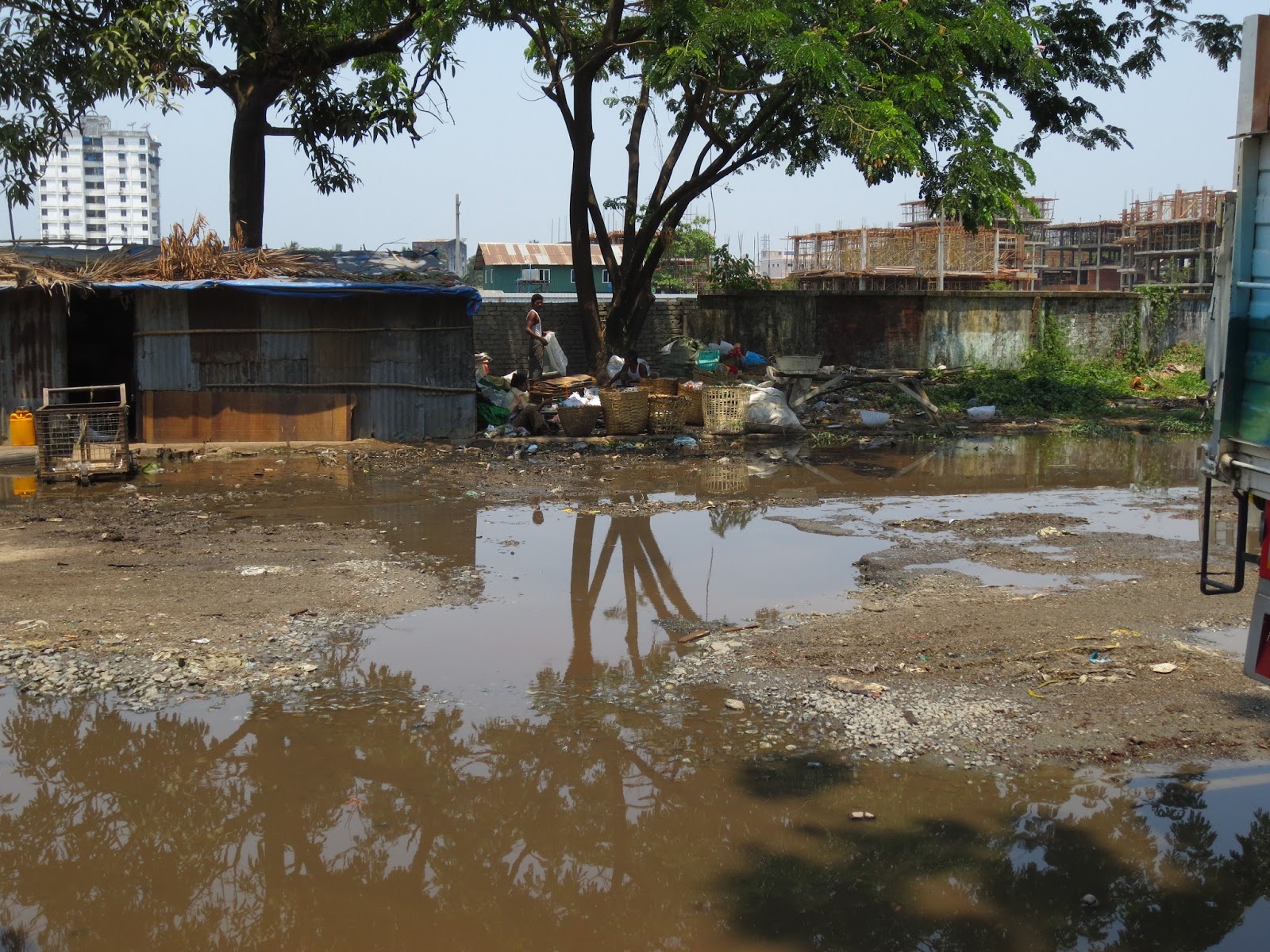
We settled in our hotel, way on the east end of Yangon. Despite the intense sun, we decided to set out on foot and see what was in our neighborhood.  Though this area was definitely still part of the capital city, only 40 blocks from downtown, the roads were already unpaved dirt. It took me 10 minutes to realize I needed to get over pointing out visible poverty whenever I saw it. We walked by grease-stained mechanics laboring over truck-sized tires, road sized restaurants with dirty umbrellas and cheap plastic stools and a storefront filled with young women packaging bundles of paper. Like Manhattan, downtown Yangon has numbered streets streets, increasing from east to west (our hotel was on 63rd). Unlike Manhattan, there are few street signs, so we had a difficult time figuring out whether we'd reached the low 50s, where we were told we could find mohinga, the fish soup noodles that defines the region's cuisine. Jackie and I had agreed that we would not eat street food in Burma, because really, our trip was too short to spend it all on a toilet (or squat hole). Yet minutes later after sorting out our various options, we found ourselves basically eating at a Burmese Dai Pai Dong, or open air street restaurant. An hour later at Bogyoke Market, we sampled some glutinous buns which really could have been cooked everywhere. I clenched my stomach, stayed vigilant for any ominous internal bubbling, and hoped for the best.  The boy waiter who served us the mohinga might have been 13, and it took us about 5 tries to understand him asking "egg?" The soup that came was flavorful, but the noodles quite thin and the whole dish generally featured less ingredients than we were used to.

Thus began a slow hypothesis that we'd confirm throughout the week - Burmese food isn't very good.  If you know Southeast Asia even slightly, this should come as a surprise. As I'll get more into later, Burma is a diverse region, variously meshing into India, China, Thailand and Malaysia, all countries of culinary renown. Multicultural hotspots like Malaysia and Singapore tend to be food heavens. If we were expecting Burma to be the same, we were a little forewarned by this passage from The Lonely Planet by local writer Ma Thanegi:
Myanmar cuisine does not use coconut, green chillies or sugar like in Thailand. It is neither as delicate as the steamed dishes of China nor as fiercely hot as Sichuan cuisine. It does not use as many aromatic spices as India.
That's a lot of "nots" associated with Myanmar cuisine. To be fair, I would enjoy the Shan noodles I'd find several times, and the simple salads were fresh and delectable.  But coming from a food-obsessed city like Hong Kong, where people vacation just to eat and you're expected to bring back goodies from trips, it was hard to not be disappointed with the options available.  Even the Indian and Chinese food I had, bland Biryani and almost American-style stir-fry, were unremarkable. When I thought about it more though, high quality food certainly has a lot of unnecessary and expensive garnishes that we shouldn't expect or complain about in Myanmar.

Walking around downtown Yangon, there were far less beautiful white colonial buildings than I had imagined. Wikipedia had told me Yangon had the most of those in Asia.  It took me a while to realize that the decaying, moldy and greying 4 storey apartments in front of me were the colonial buildings, and they had not gone well-maintained since independence. It saddened me to think that, while I'd love to criticize colonialism any chance I got, in at least this one way, Rangoon might have been nicer than modern day Yangon. The city also wasn't as crazy as I expected. Coming from the states, some of the stuff I've seen in China, like a kid throwing a baby bird in the air or women fighting over shopping carts, struck me as crazy. Yangon was pretty ordered - peddlers didn't overly pester us, monks walked around unnoticed and people just went about their ordinary lives. Perhaps the craziest thing I saw was a person with a beaver tail for a head of hair.

We walked all the way to Lucky Seven tea shop, a much ballyhooed part of our Lonely Planet guide. I examined the tiny squat bathroom and decided I was not risking tea, which in hindsight was unfortunate. Jackie had mohinga again and claimed it was better here.

Making our way to Shwedagon Pagoda, we hit up our first photogenic tourist site. Though the pagoda is huge and visible from several main streets, centered at a gigantic traffic circle, the site was so large that walking in, we weren't really able to see it. There are four large stair entrances at each cardinal direction, leading to a complex of temples and shrines centered around the enormous gilded pagoda. Standing there in the late afternoon sun, its glory and dominance did set in and I was awed by a heritage wonder as I'd only been a handful of times before. It was large, it was beautiful, it was ornately decorated, and simultaneously fit in perfectly and didn't fit in at all into this city. It fit in because essentially the city has grown around Shwedagon in the last 1000 years, looking up to and up with the pagoda. It didn't fit in because it was spotless and pure in a country with many scars and problems. We lounged around with other tourists, all of us barefoot, through sunset and into the night and thought about all the kings and queens who had knelt before or contributed gold.

We met up with Chris and Tara later, a married American couple in the Hong Kong ultimate scene who we had semi-coordinated this trip with (leaving them to presume incorrectly that we were also a couple).  We laughed at our mutual American humor as we wandered through the deserted dark streets towards the river. Yangon is not a city of nightlife and it seems most of the inhabitants have a 9 oclock bedtime or a Junta-imposed curfew. The riverfront was also surprisingly barren - I had never been to a major city with a river that hadn't taken advantage of the river. I mean there are cities in New Jersey that have nice river fronts. But here we had reached the river and all we found were some scary stray dogs, some industrial docks, and one restaurant that seemed semi-promising.  We got a few beers there and got kicked out at 11. It was ok, we had a 6am flight to Bagan the next morning anyway.