Friday, November 18, 2022

Layoffs and Relationship to Work

I was so nervous as I finished typing out my resignation letter. I looked up resign in Chinese, 辭職, prepared what I'd say, and trembled as I walked over to my manager. He initially refused to accept it, telling me to think about it til the end of the day. Had I considered a different team? Transferring to London? Arup had been my home for over 4 years, and neither side took the idea of splitting lightly. When he did accept it, I followed through with the standard one month of notice and worked as hard as ever to wrap up and document my projects. The phrase "好頭好尾", literally "good head good tail" but idiomatically start well and end well, rang through me as I felt an obligation to coworkers and clients to leave everything in good standing. On my last day, my colleagues surprised me with a cake and a sweet card with a fold-out Hong Kong junk boat which I've kept to this day.  That was the last time I left a company with good vibes. Since then I've had four layoffs and one ignominious resignation. 

This time, it was the Microsoft Teams App that foreshadowed something might be wrong. Teams lets you know when someone starts a meeting, and at 9am when my 1 on 1 with my boss was set to begin, it was my boss' boss who instead started the call. This unprecedented gatecrash couldn't be good. He got right into it, delivering in his business-like manner how my role had been eliminated in a non-performance based restructuring across the organization. He refused to tell me who else was affected, although he said it affected a lot of product managers and not data scientists. Ironically I had switched from data science to take a product role but had been coding data science work for the last month. I asked if I could just be a data scientist here. The director was initially stymied, then replied, "that option isn't on the table, but you can reapply for those roles." I had to suppress a laugh. There was no need for "好頭好尾" - within an hour my accounts were disabled.

Layoffs expose the transactional nature of jobs. With system accesses revoked, suddenly you have no ability to message your colleagues, no way to retrieve old emails or other important documents you'd inadvertently saved on the work computer on which you'd spent so much time. You find your phone left with useless apps which you just delete. You've still got loads of activity in your brain space concerning project details, or a to-do item, or how to access a particular dashboard. These all go from being critical to your livelihood to complete irrelevance. People whom you used to speak to weekly or daily soon get forgotten. One second this company needed you, the next it doesn't. 

Reactions come in waves. The initial event delivers somberness and shock, even in the cases when I knew it was coming. The tone of the conversation is so unnatural. In my first layoff, my boss had been too ashamed to look me in the eyes, and read corporate speak from a script. In my second, a seasoned HR professional sent me off as one of many in a sequence, able to show perfunctory sympathy but clearly eager to get everything over with.  In my third, my boss read a script then immediately signed off, displaying the backbone of a jellyfish as a young HR leader talked through the details. This past one was actually the most pleasant experience of the four. 

There's the horror when you reflexively try to access your email and find yourself locked out. There's the indulgent joy slacking off from all the work you'd thought you'd have to do. There's the sharing of the news, and the steady outcry of support from friends. There are offers of free drinks and plenty of reasons to accept them, and lots of laughter, mirth and sympathy.  The criticism of the company or coworkers that you'd held in come gushing out. Layoff day is a hell of a holiday.

Then there's the next day when you wake up and realize that you have nothing to do. No commute, no first meeting, no reports to review. There's seeing your company's posts on social media, marketing posts with trite descriptions of business problems that now induce vomit. There's freedom, the perks of exploring areas and venues in broad daylight.  There's the shame, the self-doubt, the retrospective analysis of assignments and meetings and wondering if there's anyway you could have done better with the people who made this decision, if you're truly unlucky or just bad or somewhere in between. There are trickles of emails and LinkedIn messages from coworkers revealing which of these transactional relationships might have evolved in something slightly more. There's the updating of the resume, the responses to recruiters even as you figure out what next steps might possibly be.  As the days go by, a new normal starts to establish itself, but small memorandums of the lost life creep back in - a business card, a bookmarked article, a conference badge. 

Work does not need to be so transactional. In previous generations, many people worked for the same company their whole lives. Single factories could provide a sense of community for an entire town, and their closings were often devastating. But in 2022 America, the tech industry has reached a state where rapid growth and reactive pullbacks have become standard. Several companies have demonstrated success by faking it until you make it, operating at losses for many years, doubling down on unbridled blitzscaling, and reaped staggering financial rewards for their efforts.  Despite plenty of examples of burst bubbles and failed startups, human nature fixates on the winners. Investors and entrepreneurs buy in on these dreams together and an entire system emerges upon an unrealistic foundation. Employees took a back seat to shareholders. Since the pandemic began and upset society's preexisting rhythms, the economy has seemed extremely kneejerk-y. Stocks collapsed with the first lockdown, then soared disproportionate to fundamentals. Tech companies entered into an arms race that they couldn't sustain, and pawns like me got caught up in it. 

Personally, this layoff caught me at a terrible time. I was already struggling, and this layoff isn't even the major negative event in my life. While I do see some potential upside as I didn't exactly love this job, I don't feel confident entering a tight job market alongside tens of thousands of Meta, Twitter, Amazon and other tech employees. What hurts worse though is the time and effort I spent at this last job, now seemingly wasted. I've worked in so many industries - buildings, manufacturing, agriculture, gas utilities, electric utilities, trucking.  I know about the silking phase in corn growth, the operations of 811 call centers, and the seasonality of truck prices Florida inbound. All the effort to grasp a new industry seem for naught. 

Intellectually I know that this is not my fault, that none of these layoffs were my fault. Never have I been fired for underperforming, never have I compromised my integrity. I know that I'm a badass data scientist and product leader who's fun to work with and valuable to society. But it's hard to justify how you can have this much bad luck without wondering if you are the problem.  

I don't think it's healthy when work becomes too great a part of one's life. Companies are not families, and work will not love you back. But there is a balance, and the degree to which my last few jobs have felt so transactional is not healthy either. With remote work and camera-off cultures, lots of coworkers feel like faceless mercenaries. It makes me resentful of the number of hours I spend with them, without a relationship growing, instead of with my friends. Ideally coworkers can reach a state of mutual respect if not mutual admiration. It hurt so much when my boss ghosted me after my recent layoff - it made me question his intentionality in any of our previous transactions. I had learned his kids names, his high school track times and we had joked about sports. Suddenly he did not need me to drive a product roadmap and any desire to talk to me vanishes. 

I believe there is room for human connection and basic decency even in competitive corporate cultures. We are all here on earth trying to do the best we can.

Saturday, September 17, 2022

The Rest was History

When planning where to travel with friends, exploring recent war and genocide history is typically not the deciding factor. However, my friend Sam and I were surprised to discover a mutual interest in understanding the Bosnian civil war, a topic I daresay few of my other friends would be interested in, and we decided to make Sarajevo the focal point of a trip to Eastern Europe (piggybacking off my week in Portugal with family). We met up in Budapest, and originally I wanted to start this blog from there, but so much happened in the Balkans (the former Yugoslavia) that with apologies to the great Hungarian capital, I have decided to skip over Budapest entirely. Our jaunt through territory that had passed through many empires would be steeped in history with a side of modern day fascism.

We drove west from Budapest to Lake Balaton, a resort destination and the largest lake in Central Europe. We were pleasantly surprised when the restaurant I randomly picked welcomed us with a sweeping view of aquamarine water. Lake Balaton also comes with kitschy craft stores, a bizarre Stations of the Cross setup complete with 14 crosses laid out across 100 yard on a hill, a rocking nightlife scene that we didn't get to experience and a car ferry which we did. 

Crossing the Hungarian border got us some perfunctory questions and a passport stamp. As we entered Croatia, a line of trucks a half mile long faced us, with bored drivers standing outside their trucks, waiting for whatever inspections were needed to enter Hungary. We gave this horrific line a passing glance of curiosity, unaware of what it foreboded.

Croatia is oddly shaped, like a C. The most well known parts of Croatia, including Split and Dubrovnik, border the Adriatic sea at the bottom of the C. Our trip passed through the top of the C, a region known as Slavonia, with its capital Osijek our planned stop. Osijek boasts an old Habsurg-era stone fort, complete with a dry moat. The fort interior now holds restaurants, bars, parks and our hotel. The city also had a charming trolley and old town square with no obvious tourism - it really felt like an unexplored gem. I wondered if the hotel concierge / bartender was at all curious why these two Americans of different ethnicities had wandered through this town, but when I engaged with him, he displayed absolutely no interest.


We continued through slow rural mountain roads into Bosnia and Herzegovina where signs alternated between the Latin alphabet and ћирилица. Our map showed a curious dotted inner border indicating we were in the Republika Srpska part of Bosnia. I spent much of the ride researching what that even meant, and only then realized I had fundamentally misunderstood the outcome of the Bosnian civil war.

A college course on Europe and Nationalism assigned us a book of poetry written during the war by a Bosnian poet besieged in Sarajevo. I remember asking at the outset how the different sides, who all looked the same and spoke the same language, even recognized who the enemy was. How could there possibly be genocide amongst these white people? The professor said I'd understand after reading the book. During the pandemic in 2020, I found the book, thought back to my question, and realized I still didn't know the answer. So I re-read Sarajevo Blues and got absorbed and kept researching. I learned that the different empires that had dominated the Balkans over the years, namely the Austro-Hungarians, the Ottomans and the Venetians, had created borders that split these people up. Political borders can forge new identities independent of ethnolinguistics - as a Hong Konger, I get this. To oversimplify, the folks living within Austro-Hungarian and Venetian territory, called Croatia, became mainly Catholic while those living within Ottoman territory, called Bosnia and Herzegovina, largely adopted Islam. The territory of Serbia changed hands between these empires but achieved independence in 1815, with its inhabitants overwhelmingly following Eastern Orthodox Christianity. 

Nationalism was sweeping through Europe and the independent Serbs wanted to liberate their fellow South Slavs from their imperial yokes and create a Greater Serbia, with them in charge.  World War I started in Sarajevo when Serb nationalists, who might not have had direct ties to the Serbian government, assassinated the heir to the Austrian throne. The outcome of two world wars eventually did lead to the union of South Slavs in socialist Yugoslavia. By all accounts, though Yugoslavia's capital was Serbia's Belgrade, nationalism was kept in check by the dictator Josip Tito during this time. However, when Tito died, nationalism erupted again. Slovenia, Croatia and Bosnia all wanted to be their own countries, and the idea of Greater Serbia regained popularity. Because there'd been no internal borders during Yugoslavia and identities are fluid, plenty of people who identified as Serb lived in these areas, especially in Bosnia. Serbs were used to being the dominant ethnic group but now faced the prospect of being minorities. When Bosnia declared independence, many of the Bosnian Serbs had been preparing and quickly showed up around Sarajevo with artillery. They nearly conquered the city in the early days of the war, but ultimately settled for an endurance approach with a brutal siege that lasted over 4 years. I learned from this history that the most dangerous people are people formerly in power now facing a loss of that power - a situation very relevant to the United States in 2022.

Sarajevo itself had been a bastion of multiculturalism where Bosnian Muslims, Croats and Serbs had lived side by side. Before World War II there was also a substantial Jewish population. With synagogues, mosques, Catholic and Orthodox churches, Sarajevo was called the Jerusalem of Europe. Though the Yugoslavian wars pitted religions against each other, religion hadn't been such an identity marker in Sarajevo itself, since like most cosmopolitan European cities, atheism had been growing. Many Serbs ended up fighting alongside Muslims during the war, and the Bosnian government was careful to label the other side "Chetniks" or extremist Serbs and avoided demonizing all Serbs. The war was not Muslims vs Orthodox but those who believed in a diverse Bosnia vs Serb nationalists. I learned that identity is all what we choose to make of it - all differences amongst humans are simply ones we've chosen to believe are differences.

Republika Sprska is non-contiguous with very irregular borders and a "capital" in Banja Luka. I had thought that at the tail end of the Bosnian war, US & NATO got involved, bombed the Bosnian Serbs and helped the Bosnian Muslims win the war. In reality, the Dayton Accords peace treaty that ended the war wasn't really a victory for any side. The Dayton Accords carved three autonomous regions in Bosnia more or less based on where the armies were, one to each side and one in the middle that they couldn't decide on. The regions are so autonomous as to be functionally separate countries, with a very weak Federal government. The Dayton Accords also created the unusual position of High Representative, a person chosen by other nations to have total veto power over the Bosnian government. Essentially everyone realized the two sides would fight over legislation and thus implemented an overlord to babysit the country, until they showed they had sufficiently grown up. The current High Representative is a German man who speaks no Bosnian.

All this I was absorbing as we drove past Cyrillic signs in the Republika Srpska. The only flags we saw were the flag of the Republic of Serbia, and the Republika Srpska's similar own flag, both using red/white/blue horizontal bands. Given the history of the war, the refusal to fly the blue and yellow Bosnian flag and insistence on the Serbian flag is asking for a fight. We saw police checkpoints periodically on the road, where a policeman asked for our passports and registration in German before letting us move on with an "alles gute!" Even as outsiders, we felt the tenseness of a frozen conflict.

Across the river from Serbia proper, in the city of Zvornik, we stopped for lunch. Walking into a random restaurant, the owner greeted us like he had never seen a blue-haired Asian man before. No one spoke any English, and our Bosnian-Serbo-Croatian was limited to about 5 words. He offered us a drink, and I indicated a no, and he gave an aha and hurried into the kitchen. We awkwardly took seats and marveled at the table cloth decorated with cigarette burns and the pictures of Jesus and Putin side-by-side on the back wall. The toilet was a squatter. After about 15 minutes, Sam asked if we should just grab snacks at a convenience store, but I replied with 50% confidence that the owner was probably cooking for us. And so he did return out with a steaming tray of barbecue and stretchy bread. Considering we literally did not order, it was the best possible outcome in that Putin-worshipping restaurant.  


After two hours on mountainous country roads, we arrived at Srebrenica. In July of 1995, after intense negotiations, Dutch UN Peacekeeping troops handed over the Bosnian Muslims who had been under their protection. Over 8,000 boys and men were separated from the group and methodically murdered by the Bosnian Serbs in what the US recognizes as a genocide. A genocide memorial has been set up over several acres of grassy hills. Reminiscent of the Holocaust memorial in Berlin, gravestone pillars are setup in a grid, each representing one of the slaughtered with an Islamic burial epithet written in Bosnian. Signs in the front were written in Bosnian, English, Turkish and Arabic. Across the street, where the Dutch UN headquarters had been, dilapidated buildings house exhibitions about the massacre. The buildings lacked any markings, and seeing broken windows and empty door frames, I was skeptical that it was a museum at all. I was shocked to find inside a well curated assembly of personal items and video recordings from survivors. It struck me that this memorial was deep within the territory of its perpetrators, the area having been awarded to Bosnian Serbs after they had cleansed it of Muslims. The Bosnian Serbs unsurprisingly showed little interest in maintaining the memorial, evidenced by the near absence of road signs to it. It crossed my mind that the restaurant owner from earlier was old enough to have served in the Serb army. We spent well over an hour in Srebrenica and saw maybe a dozen other visitors, understandable given the remoteness. I wondered if any other memorials in the world could match Srebenica in this unusual combination of being distinguished yet unvisited. 

Finally, in a spectacular sunset drive descending from the mountains, we reached Sarajevo. The city met our expectations. It attracted just the right amount of the right tourists, those who have also put in the requisite Wikipedia research. Minarets and calls to prayer reminded us we were in a predominantly Muslim city, but the nightlife indicated that this was "Islam lite" and still very much a European city. We stayed a block from the Latin Bridge spanning the Miljacka River and the site of Archduke Franz Ferdinand's assassination. A memorial featuring a metal imprint of assassin Gavrilo Princip's position when he fired his gun struck me as a strange glorification of murder.  Nonetheless, the site conveyed how this restless, diverse city had been a happening place and would witness so many events of consequence just in the 20th century.  Of course, our neighborhood had more to offer than Sarajevo's dark history - a delightful mix of restaurants, shopping, gelato, bakeries and bars made me want to explore every corner and nook. A historic market square called Baščaršija hosted a lovely scene of elderly folk sitting and drinking Turkish coffee in the mornings surrounded by ancient stone buildings.


A guided tour of Sarajevo took us to a damaged and graffitied bobsled trek in the mountains east of the city. Sarajevo had hosted a successful Winter Olympics in 1984, only 8 years before war would engulf those venues. It's a travel hobby of mine to visit Olympic cities and look for Rings or the host stadium, but with Sarajevo, a dilapidated concrete slide seems to better represent the city's Olympic memory. The tour continued to the Tunnel of Hope. With the city besieged and constantly shelled by artillery, an 800m long tunnel was dug underneath the UN-controlled airport runway. The tunnel allowed supplies to be brought in and likely saved the city from capitulation. As the airport runway is still used, most of the tunnel is not made accessible for tourists. We were able to walk through a small authentic stretch, and while it was crouchingly tight, it didn't reach the claustrophobic levels of the Cu Chi tunnels in Vietnam. We continued to the War Childhood Museum, where stories of children during the war were documented. The museum reminded us that when we talk about nationalism, and geopolitics, the effect on people's lives can get lost in the large numbers, but when we are shown war's effect on the innocent individual, we understand better what is truly at stake.


We drove southwest along the gorgeous Neretva River to Mostar. The 5th largest city in Bosnia (technically in Herzegovina), I'd imagined Mostar to be a bit of a random spot with an elegant old bridge. Imagine my surprise when I arrived to find out Mostar is the most popular destination in Bosnia. Old Bridge, or Stari Most in Bosnian, was originally commissioned by Suleiman the Magnificent in 1566. The entire structure of the bridge, included the walking path, soars over the Neretva at such an acute arch that the original builder, so worried it would collapse, prepared for his own funeral after it opened. Instead, Stari Most stood as a wonder for over four centuries until the civil war when Croat forces, not Serbs, destroyed it. Though they claimed the bridge was of strategic military value, the general who ordered it was convicted of a war crime. The bridge was rebuilt in 2004. Now, its every inch and every viewing angle is capitalized, with wall-to-wall restaurant coverage along the riverside. A man was diving off the top of the bridge every couple hours with his accomplice collecting money. Initially confused on where this influx of tourists came from, I realized that Dubrovnik, aka King's Landing,  was just over 2 hours away. While the main town square was cobblestoned and charming, the touristy nature made me believe it was designed to look charming. Outside the center of town felt more authentic with many shelled buildings still in ruins, and inexplicably a statue of Bruce Lee in a park. 15 minutes drive away was a Dervish House, built into a cliff alongside where a river enters a cave. Though this was also extremely touristy and I was unable to appreciate the Islamic spirituality of the location, Sam and I did find a rocky hiking path ignored by everyone else that led to scenic views of the valley, and randomly some climbing equipment.


We had decent luck meeting interesting people in the Sarajevo bar scene. A tall German got to talking to me and Sam at the bar, while his girlfriend remained at their table for 15 minutes. Gathering that his girlfriend was Nicaraguan, I asked if we could join them at their table. The German replied, "sure, but uh do you talk the Spanish?" An hour later he remarked, "I definitely wasn't expecting the two Americans to speak Spanish...in Sarajevo." We learned that they were waiting for a Schengen visa to process and had somehow survived 5 days in the boring Banja Luka. The next night, after failing to strike up any conversations, a group of young Bosnian guys approached us out of nowhere. What transpired was tremendous for we had lots of questions for them and they had lots of questions for us. Some question examples were: 

"You could've chosen Spain, Italy, France, Germany - why did you come to Bosnia? What do you think of Joe Biden? Do most Americans have guns?"

And my questions for them included:

"Who did you root for in the World Cup when Croatia made the final? Would you root for Serbia if they were in the final? Do most people drink here? Do you think there will be another war here in your lifetimes?" One of them responded, "When we're in the Balkans, we all hate each other. When we're outside the Balkans, we realize we're all the same. I rooted for Croatia and I could root for Serbia." With regards to drinking, Bosnian Muslims either drink alcohol or smoke hookah, with very little overlap. Avoiding pork was far more commonly followed. I enjoyed tremendously watching how they interacted - I was shocked to see how much internet meme culture, jokes that I thought were English-specific, was part of their lives. One guy demonstrated via meme about how his friend was a ladies' man, with a picture of a man videochatting 50 phones. The tallest of the group, a good looking guy with glasses and a crew cut named Harun explained his position as one of 4 Bosnians at a US sponsored army training program in Turkey. He said there would only be war again if the US allowed there to be a war. 

We got up early the next morning, unfortunately smelling of Bosnia's lack of indoor smoking regulations, and set out for Belgrade. Sam had messaged his Serbian-American friend Igor when we'd previously driven along the border, and in an incredible coincidence Igor told us he was currently in Belgrade. We changed our plans to swing by Belgrade. Igor had moved from Belgrade to the US when he was 5, but he spoke Serbian fluently and knew Belgrade pretty well. As he took us through historical squares, respected restaurants and a Roman-era fortress, I recognized in him a joy of showing Americans a country he knew intimately, a joy I shared when friends visited me in Hong Kong. He gave us a culinary tour with cevapi, which I recognized as the barbecue plate from the Putin restaurant, the soft yet crispy pastry borek and a dessert shop with delicious knedle, potato doughballs filled with chocolate or fruit. He explained how Serbian soccer was talented but disappointed in big tournaments, how much people revere Nikola Tesla (born in Croatia to Serb family) and NBA MVP Nikola Jokić, and how they also take credit for Slovenian  Luka Dončić who "has a very Serbian name." 

Though he'd spent decent time as an adult in Belgrade, Igor hadn't really partied in the city with friends. Apparently Belgrade is known as a party town, with Europeans from richer countries often coming to splash for a weekend. Through extensive Instagram research, he chose some bars and clubs and we went hopping. We were a few drinks in and quite tired from the long day when we reached our final club, but the cool design and 90's music revitalized us. We knew all the lyrics and so apparently did the Serbs. Igor ordered each of us a shot of the Serbian national drink Rakija, which he subsequently described as "moonshine brandy." After an hour or so, I was feeling in a good place, until I turned around and saw six more shots of Rakija arriving which Igor had apparently ordered in Serbian. I stumbled home at 1am and puked so badly I made it to the sink because I couldn't reach the toilet. I felt terrible for being a drunk mess until Sam came home and started his own chunder show. We traded puking bursts all night. I started to feel stable around 9am, but Sam was still in bad shape and not helped by our need to drive 3.5 hours back to Budapest that day. 

Mercifully, a dual carriage highway connects Belgrade and Budapest, and we didn't have to deal with the hairpin curves through Bosnian mountains on a hangover. The most notable sight were numerous signs in English saying "Kosovo is Serbia." While we had been primed to look out for anti-Bosnian sentiment, it was another conflict with NATO involvement that still riles up nationalism. The 1998-1999 war with ethnic Albanians trying to breakaway had ended in NATO bombing Belgrade and Kosovo becoming de facto independent, although it seems none of the highway signs agree.  I thought about how much pride played into these conflicts, with people willing to kill each other over perceived historical wrongs.

As we approached the Hungarian border, Google directed us off the highway and onto a small road where all the cars were stopped. I was confused when a woman exited her car with Slovakian plates and took her dog for a walk. We had never expected to wait at the border. I walked out as well, and in addition to the hundred cars ahead of us, abandoned buildings and barbed wire gave me an uneasy feeling. Piles of litter contained old clothes and broken tents hinted at a former refugee camp of sorts. Suddenly I realized we were "entering Europe." It had not dawned us the entire trip that we had left the EU - Bosnia and Serbia are not member nations. Hungary has famously been unwelcoming to migrants at its border, and this crossing of Horgos had been the site of clashes in 2015. I suspected that our lengthy border wait was both typical and planned. It took us two and a half hours to get to the customs officers (who seemed genuinely surprised to see American passports) and two minutes to get past them. We finally made it back to Budapest where we checked into an airport hotel, returned the car, and fled with our tails between our legs, more knowledgable of the potency of Balkan conflicts and moonshine brandy. 

Tuesday, March 29, 2022

City Centers

My first company Arup has an internal company directory. It's basically Arup Facebook where employees share their headshot, professional qualifications, expertise, project experience, as well as personal interests. One field "Proudest Achievement" could be either, and revealed a lot about one's personality. Years later, I still remember my friend's achievement: "High fiving Michael Jordan."

You can search for coworkers by name, or by office. Sitting in the company's largest office, I was often intrigued by the smaller offices around the world, in faraway places. There's an office in Mauritius that had probably 40 people. Mauritius, the island nation off the coast of East Africa with British and French colonial history and possibly the world's most diverse populace. I browsed through the office employee names and saw someone whose name looked a lot like mine. It could have been Christopher Lim or Calvin Liu or Kevin Lee or something. He was definitely Chinese but Mauritian, a Graduate Engineer who had graduated university in the UK. He was a Manchester United and F1 fan. As I stalked read his profile, I couldn't help but feel an incredible sense of connection - I felt from his interests that we had similar personalities, perhaps even similar life experiences despite our wildly different places of birth. I wondered, would I be him if my parents had chosen to move to Mauritius instead of the United States? It suddenly seemed less preposterous a hypothetical. What would that have been like? Here I could see one manifestation of that alternate universe, as a skinny engineer who grew up watching David Beckham, speaking English, French and Chinese (maybe Hakka?), playing Starcraft, and now working at the exact same company as me.
Publicly available photo of Arup Mauritius office

I grew up believing the United States to be the center of the world. I wondered how anyone else could interpret the world any other way. With its geopolitical might and the immigrant melting pot legacy, American exceptionalism is core to our upbringing. Even our immigrant tale is inextricably spun with a sense of superiority, about people finding a better life in this better country. Somehow I was educated with the misbelief that the US was the only country with substantial immigration - in my mind, the other countries were monocultures with little desire or ability to accept immigrants.

I'm not sure when I discarded this myth, but by the time I was working in Hong Kong, my peer group included overseas Chinese from Canada, Australia, UK, Ireland, Malaysia, South Africa, New Zealand, France, Italy, Germany, Singapore, Panama, Indonesia, Tanzania and so on. Everyone was well-adjusted, well-educated and often substantially more interesting and multilingual than me.  When I discovered my Mauritian doppelgänger, I had completely detached American-ness with exceptionalism.

So this is actually a post about New York. I know, that was a long walk. But hear me out. My life in Asia re-centered my world. With over 4 billion people, the majority of humanity, living in Asia, how central could America possibly be? Asia and its billions had rewired my ambitions, dreams and definitions of "cool" or "success." 

When I moved back to Boston, I found myself walking past buildings downtown, including the high rise on State Street where my mom worked. As I watched suits dashing by, I couldn't help but think how provincial it all felt. I imagined these people trying to climb the corporate ladder at these downtown offices to get club seats at Fenway Park and a seat at a gala hosted at the Isabella Stewart Gardner museum. It was jarring to realize that I used to want that life.

And then I moved to New York. Having grown up in Boston and gone to college in DC, New York had always loomed large. For so many in my peer group, New York City was their dream. Many of my friends didn't even consider jobs in other cities post-college - many probably didn't even wonder if they'd enjoy living here, they just figured it was the path they should take. Landing a job and moving to New York represented success. But for me now, it just represents this concrete mass with a decrepit subway system and an obsolete class system where a lot of high paying US jobs happen to be based. The city's self-centeredness clashes with my rewired sensibilities, and my peers reeked of default choices.

My mentality in NYC was edgy.  When asked how I was enjoying the city, I wanted to summarize the previous 8 paragraphs. Instead I'd deliver some snippy response meant to establish my cosmopolitan credentials, point out my barbs against the city while minimizing offense at the questioners' invariable New York pride. I was so preoccupied with distinguishing my attitude that I struggled to enjoy the city as it was. I took in the skyscrapers and the street food and those flimsy metro cards as someone else's ideal city, and told myself I was just here for a job. 

*****

I'm not sure exactly when I wrote that. I'm picking this up in a different city, a full two years later. The last few paragraphs don't entirely jibe with how I feel about New York, or how I remember my experience there. I was only 8 months in when Covid-19 shut the city down and my East Village apartment suddenly felt very small. I ended up moving out in the beginning of May, and though I thought I'd be returning, I didn't. 

At some point it became clear that I'd need to start over somewhere, and it wasn't going to be in Asia. At that point, moving back to New York didn't feel like moving back - it felt like starting over. Considering I never fully felt like I vibed there, I instead sought out a place where I did feel some connection. Seattle ended up being the only choice.

Unlike New York, Seattle has no pretenses about being the center of the world. Similar to Boston, it is a small city tucked away in a corner of the country but makes up for the lack of size and geographic centrality with outsized economic and cultural impact

Sunday, March 13, 2022

The Great Leap Forward

 Rarely does a story touch on as many issues personal to me as Eileen Gu's 2022 Winter Olympics run representing China. Olympics, China, America, international sports - it's a quadruple lutz of meaty topics. Her Winter Olympic performance across three events - Big Air, slopestyle, and half pipe, all on skis - netted her a gold, silver and gold and made her arguably the most memorable individual of the Games. The unique intrigue to the story however was her representing the host China, despite being born and raised in America. Her decision and citizenship status raised a lot of speculation and generated controversy in some minor subcultures of American society. 

Here are the facts - Eileen Gu was born in San Francisco to Yan Gu, a Chinese winter sports athlete who had moved to the US for Master's studies. Her father's identity is not public, but he is known to be a white American and to not have had a major role raising her. Eileen was born a US citizen and given the omniscient Chinese name of  爱凌 Ai Ling, meaning "Love Ice" but also sounding like Eileen. In some ways it seems her upbringing was very similar to that of an ABC (American-born Chinese), speaking Mandarin with her mom and maternal grandparents. However she spent a lot of summers in Beijing and it's pretty clear she has a closer grip to Chinese culture and Mandarin than the vast majority of ABCs.  In 2019 when she was 15, she decided to change her affiliation from the US and compete for China as a freestyle skier. 


Eileen has explained some of her reasons for changing, touting her close affiliation with China and her desire to inspire the Chinese youth to take up winter sports. Outsiders have speculated cynically that she did it for sponsorship reasons, soaking up the spotlight in the massive Chinese market in lieu of the crowded American one, or that Chinese propaganda had brainwashed her. The lowest rung of hateful American conservatives have branded her a traitor, a mouthpiece of the Chinese Communist Party, and the "worst person in the world". Furthermore, as Chinese nationality laws prohibits dual nationalities for anyone over 18, questions have arisen over whether Gu has given up her American citizenship.

As is often the case with personal attacks, they reveal less about the victim and more about the insecurity of the attacker, in this case insecurity in America's global status. International sports have long struggled over rules designed to create firm team boundaries in a world full of fluid borders and identities. Examples abound of individuals representing countries other than their birth place for all sorts of reasons, to the extent that this Wikipedia page goes on and on.  Lots of people immigrate and choose to represent their naturalized country, like Somali-born distance runner Mo Farah who won gold medals for the United Kingdom. Others choose to represent the country of their parents, often because they are not good enough to represent their birth country, but sometimes because they want to support their heritage nation, like French ⚽ star Riyad Mahrez playing for Algeria.  Most international federations allow athletes some flexibility in choosing their sporting nationality.

As a nation of immigrants, USA sports have particularly benefitted from dual nationals, including athletes like Philip Dutton, Kaillie Humphries and Bernard Lagat who competed for the USA after having won Olympic medals for other nations. In many sports, the US revel in naturalized citizens. On the flip side, for the US men's ⚽ team, nearly half the stars are Europeans who happen to have a US passport for one reason or another. I suspect when the culturally French Jordan Pefok scores for the US in the World Cup, no one will complain about how he can't speak English. Meanwhile in sports where America excels, many athletes who miss the US cut often find their ways onto other countries' teams, such as WNBA star Becky Hammon playing for Russia. 

What America rarely sees is a homegrown superstar choosing to represent another nation. Even more notable is when that other nation is a geopolitical rival. America has long been the country where athletes can make the most money, garner the most fame and live the best life. For someone to choose China over America reveals a truth that's difficult for so many Americans to swallow - that China can compete with the US on market opportunities and perhaps even quality of life. The outrage over this sports story is fundamentally an outrage over America's changing place in the world.

Eileen Gu jumped into this firestorm when she chose to represent China. She easily would've been the top American competitor in all her events and a Wheaties Box idol - though granted that was not predetermined when she made her decision three years ago. Though I also am an outsider speculating, I think far less cynically about her decision. I think she just thought it would be fun. The Olympics will never be in China again in her lifetime, and it is so exhilarating to perform in front of a "home crowd." It is so much fun to appear in grand media appearances, smile on billboards, give interviews in Mandarin and be complimented on her fluency. Following her on Instagram, it seems she is soaking this all in.

Peeling back this successful stardom in China reveals the extent of colonialism in sports. Skiing in its many forms comes from Scandinavia and has spread largely through western culture. In fact, nearly every Winter Olympic sport and most Summer Olympic sports are essentially western sports. While the Olympics has tried to cultivate a reputation of facilitating truly global competition, they sometimes have the effect of facilitating Western dominance in sports they invented. All sports have regional differences based on culture, history, and access to equipment or facilities. It takes a lot of effort and time to bring sports to new countries. Skiing is particularly inaccessible, requiring snowy mountains, expensive resort infrastructure, personal equipment and instruction. No one raised in China will recreationally rise to become an elite skier at the level of skiers in Colorado or the Alps. China can only compete by intentionally finding good athletes as children and training them for these specific events. Gu is privy to her Chinese superstardom experience because she has the combination of being culturally adept in China and athletically trained in the US. It should be noted that Asian-American gold medalists like Chloe Kim and Nathan Chen don't experience the same sort of fame in South Korea and China, because they lack the ability and interest to connect with those countries.

My relevant experience is in ultimate frisbee, a sport invented in the 1970s in a New Jersey parking lot. When I played in college, there were tens of thousands of ultimate players in the US. When I moved to Hong Kong, there were around 100 regular players. The difference in level of play was enormous, and enabled an average collegiate player like me to represent Hong Kong in world tournaments. It was an honor and a thrill to attend these tournaments that were as grand as ultimate tournaments could get, wearing an official country jersey. Additionally it was meaningful to lift the level of play in Hong Kong, spread the wonderful sport to more people, and help this land where I go back 5 generations and love deeply. Even if I could represent the US, playing for Hong Kong provided a unique sense of fulfillment. I'm sure Gu felt similarly about representing China.

Regarding her citizenship, I found it pretty clear from her painful non-answers to pressing reporters that she had not given up her US passport. Admitting outright that she was receiving special treatment from the Chinese government would undoubtedly provoke a firestorm from Chinese netizens. My theory is that the Chinese government did make numerous unusual "nationality grants" to athletes in these Olympics - the Chinese hockey team was almost entirely American and Canadian. I certainly don't believe Gu will attend Stanford next year as an international student. This awkward nationality issue only arises because of China's strict rules and usually isn't an issue with European nations.

Hanging over this entire Olympics have been China's human rights abuses and general place in the global world order. What the CCP have been doing to destroy Uyghur and Tibetan identities are crimes against humanity, and I think I've made my feelings about the crackdowns in Hong Kong pretty clear. The authoritarian government in Beijing has taken a disturbingly nationalistic turn in the last decade, questioning whether these Games should've taken place there at all. When Eileen Gu wears the Chinese National Team outfit, she does in part represent that authoritarian government. However, she is also representing 5,000 years of history and the world's largest nation with a vibrant middle class. Accepting citizenship does not mean one condones everything that country has ever done, but rather that they accept the present whole, warts and all. We wouldn't like it if Russian media pressed naturalized American gymnast Nastia Liukin to answer for the invasion of Iraq. Neither should an 18 year old ski jumper be held responsible for mass internments in Xinjiang. 

The bottom line is that we shouldn't take sports allegiances too seriously. Athletes change allegiances and make surprising representation choices for all sorts of personal reasons which are rarely geopolitical in nature. We should want to move towards a world in which where one starts doesn't dictate where one ends up.

Thursday, December 30, 2021

My Language Philosophy

 "I think I'm just not good at languages."

This sentence, which I hate so much,  came out of my mouth during my sophomore year in high school. I was choosing my classes for junior year, and I had decided to drop French. My high school offered Latin, French and Ancient Greek (yes, that's it), and I had taken the minimum amount of languages - 3 years of Latin, 3 years of French. I wasn't terrible at these classes, but I didn't feel like I had gotten much practicality out of them. 

Fast forward 15 years, and I consistently spend 2 hours a week studying languages. Some of these languages had provided a lot of practicality, such as helping me escape from a remote town after all flights were cancelled. Most importantly they have helped me connect with many people all over the world, creating lots of bidirectional laughs, knowledge exchange and reducing misunderstanding.

I now feel comfortable saying I can speak five languages, though I am insecure about all of them.  I've managed to do all this while possessing no real talent for language acquisition - in fact I believe I possess a below average memory and ear. 

And so I hate it when people say, "I'm not good at languages", especially when they say it in English. It usually betrays the speaker's position of privilege. It doesn't help that often they are ignorant of this privilege. This isn't a view I've found commonplace, but I'll recount how I developed it.

As with this blog, my language story begins in my summer of 2008 in Beijing. I had come into the city alone armed with one introductory year of Mandarin from college. I also had grown up speaking Cantonese, the Chinese language dominant in the south, but that was of limited use in this northern capital. Everything was terrifying at first. Taxi rides would begin with 5 minutes of me trying to say where I wanted to go before the driver would begin driving, and sometimes they never would. I would go everywhere with a notepad and jot it down in English all the points I wanted to express but couldn't and look them up when I got home. Slowly I began to converse, but listening remained very hard. People spoke so fast and the Beijing accent is famous for its slurring of syllables. At first I thought I couldn't understand anything because I didn't know the words. But Chinese is a language with a relatively sparse word domain - a lot of complex concepts involve the bundling of more elemental words. Very often people were saying words that I had learned, I just couldn't recognize them at live speed. I needed to train my ear, listen very attentively, and load up guesses based on context. 

In due time my ear got better and I was able to have conversations by the end of the summer, most commonly to taxi drivers about NBA players. It was a rush, feeling the improvement and being able to accomplish tasks easier and getting compliments. I remember talking to my building staff, who'd seen me progressed all summer, and observing real pleasure in their eyes when I said "慢慢走" at the end of a conversation, a phrase I'd heard dozens of times from service venues. The city slowly deciphered itself as I learned to recognize more characters.

During the Olympics, loads of foreigners came to town and I found myself useful linguistically. I could help people order cabs or ask for directions. Then sitting on the subway, I sat next to a French couple looking at the subway map, clearly trying to figure out where they were. Almost miraculously, though I had always been crap at listening comprehension in my French tests, I could understand them. I told them they were going the right direction and they could transfer in two stops, in French. I realized then how much French vocab I had stored in my brain, accumulated through all the homework and tests, but it was only now when my ear had progressed that I could actually perceive the words in spoken conversation.

Language acquisition is notoriously difficult to measure, and I can't find a definitive research source for it, but by all accounts the majority of the world is at least bilingual. This certainly jibes with my experience, as is the notion that this figure drops to 23% when examining just the United States. Not only is knowing multiple languages the norm in most places but monolingualism is associated with lack of education. Especially in the global south, inability to work in a "major" language can be a major hindrance to societal mobility. For the past two centuries, there has been no language more major than English, and it is amazing how different language acquisition is treated in English-speaking countries. In these highly developed countries, outside of immigrant communities, language acquisition is treated like an elective course. There is no link to economic advancement, and no stigma associated with monolingualism. In fact, it is common and socially acceptable to say the sentence I opened this blog with: "I'm just not good at languages." This educational domain, which is treated like a core human skillset like math or reading in much of the world, is treated with an optional "let's see if they have talent" mentality in the US. While there is a talent component to learning languages, it is not a prerequisite to becoming bilingual! You cannot tell me that every single Dutch or Filipino person is linguistically gifted. This success is due to the national education system and incentives of the citizens.

The lesson is not necessarily in replicating those educational systems. I believe people in English-speaking countries are bad at learning languages because they don't need or care to be, and that this attitude derives from a position of privilege. Learning a language as an adult is difficult, stressful, scary and full of embarrassing moments. You have to accept that you will be mocked and that your brain will feel like mush. And much of the world has to go through this process to enter the global economy. English speakers need not, and that is an immense step up. At this moment in time in the US, I find that privilege is spoken about within a national context, with a perspective of shining light on the struggles some Americans face that other Americans do not. But it needs to be spoken about with a global context, of all the powers that Americans, even Americans that lack privilege locally, have to step into another country without visa-stress and expect other people to understand them. 

This privilege is so pronounced when one lives abroad. The number of English speakers who have been living abroad for years without picking up the local language is astonishing. The legacy of colonialism and the hierarchies of international trade has allowed this to be generally socially acceptable. With this context in mind this, I find it unbelievably hypocritical when English speaking countries attack immigrants for speaking English poorly.

It is true that native English speakers have experiences unique to them that I've written about before, including some that make it more challenging to learn other languages. But the reality is that learning a language is hard for anyone. It takes a ton of time and pain, but it's a challenge that most of the world has accepted is important.

If you are truly interested in global equality, you have to learn at least another language, and preferably a non-Indo European one. Not only is the acquisition process crucial for developing empathy, but post-acquisition one can access knowledge channels outside of the ones colonialism setup. And it's fun and rewarding and useful. 

Personally, I find language learning a permanent part of my life. It is usually not a top priority and so I rarely study intensively, but I have 10 year plans for acquiring new languages (Vietnamese by age 40). Not only is it rewarding to be able to connect with whole new parts of the globe, but new grammatical structures and idioms shed new light on how humans think. Good luck with your language learning.

Wednesday, July 21, 2021

Trying to Follow ⚽ as an American Sports Fan

Expectations matter so much in our enjoyment of life. Enjoyment of an experience seems determined less by the quality of that experience and more by the difference of that quality from our expectation.  Have you ever come out of a concert or show disappointed because you were expecting it to be even more amazing? Or have nights etched into your memory because wonderful unexpected shenanigans happened? I enjoy sports because of the unexpected. While well-written dramatic shows and movies may contain fun surprises, we come to expect that unexpected. I go into watching Season 8 of Game of Thrones ready for some twists and incredible reveals. On the other hand, a sporting event can be utterly dull. That final buzzer beater can miss, the winning catch dropped. All those aborted dramatic moments however just serve to make the realized dramatic moments that much more incredible - they are rare enough that we can't expect them to happen. The sheer euphoria of a great sporting moment cannot be matched by anything scripted.

I think that is what makes ⚽ such a globally popular sport. Spectacular goals can come out of nowhere, and they can literally make all the different in a match result. Many goals are unexpected events of great consequences, being both amazing athletic highlights and swinging the result of the match. In the multiple text groups I have with other people concurrently watching matches, I find many texts simply saying "wow." While basketball, football, baseball and hockey are great sports in so many ways, I find that ⚽ produces the most unexpected wow moments.

I use ⚽ because despite the advancements that humanity has made in 2021, we still cannot have one name for the most popular sport on earth. Though I'd like to rant against the international disdain of the word soccer, a word coined by English people themselves from a weird shortening of "association football", I'll just stick to emojis to avoid controversy. But to vocabulary conventions, nowhere have I found British English and American English more different than when it comes to sports discussions. Where an American sports commentator may talk about how "that speedy youngster has been got the fans of his team excited with his streak of great play", an English commentary might say "that youthful lad with great pace is exciting his side's supporters with his good form of late." An American writing about differences to European ⚽ is hardly novel. In fact, there is an entire TV series birthed from this premise, the amazing Ted Lasso show. One of the show's gimmicks is the coach who serves as a "translator."
Ted Lasso:  And today's lesson is "trick plays." What do they call 'em here again?
Coach: Elaborate set pieces.
Ted Lasso: Yeah we're going to stick with trick plays, that's a lot more fun.

Following ⚽ is not exactly new for me. The first World Cup I remember following was in 1998, and I've followed closely every World Cup and European Championship since 2010. This isn't even my first blog post about this topic. But while I did drag myself out of bed at 3am for a Champions League final or two while in Hong Kong, I hadn't really followed the sport outside of these special tournaments. I'd recognize Zinedine Zidane and Ronaldinho when they showed up at the World Cup, but I didn't really know what club they normally played for. I've nominally been a Liverpool fan for several years, because their owners also own the Boston Red Sox, but I hadn't ever watched their regular season games.

The pandemic changed that for me. First, the German Bundesliga was really the first sport to emerge from the suspension of all sports. The English Premier League (EPL) came back a couple weeks later. The games generally took place weekday afternoons and weekend mornings, times that the pandemic made much more accessible. 

Each American sport and professional league is unique of course, but their commonality is revealed when compared to non-American systems. For example, each league is divided into conferences and divisions, have a playoff system, a draft, and clocks that count down (except for baseball). Coming from this context, there is a lot about European ⚽ that can appear quite whacky.

Each country has its own league. Sorry, I meant leagues. Each country has a system of tiered leagues with relegation rules, where in each league, the best teams go up and the worst teams go down. It's a brilliant system that makes matches exciting through the end of the season and eliminates "tanking," a problem endemic in American sports. What's less brilliant is the naming system of the leagues of England (+ Wales + Isle of Man + Jersey + Guernsey but not Scotland or Northern Ireland). Here are the top 3 Leagues:
1. Premier League
2. The Championship (not to be confused with the Champion's League)
3. League One

The names are a confusing legacy of history that defies modern design, much like how hereditary peers still maintain a real role in Parliament. 

In addition, basic assumptions that we have about sports in America are violated while watching ⚽. In American sports, the clock counts down. In ⚽ , and rugby, it counts up. In basketball and football (and ultimate), out of bounds is determined by where your feet are when you contact the ball. In ⚽, it's where the ball is. In all American sports, teams in a league qualify for a playoff tournament, and the winner of that playoff is the real champion. In the Premier League, every team plays each other twice for a total of 38 matches, and that's it - whoever has the most points at the end is the league champion. This does ensure that all regular season matches are meaningful, and you don't have arguments about who the real best team is, but can also result in an anti-climactic situation like Liverpool celebrating its 2020 championship when Manchester City lost their match.

But ⚽ also has playoffs. For European men and women, the Champions League is this very cool international competition between clubs that's essentially a 32 team tournament that follows a format with some similarities to the World Cup formats - except it's actually a 79 team tournament that allows the best teams from countries like Israel, Azerbaijan and Iceland to compete to be the champions of Europe. Four leagues are extremely strong - the Premier League (England), La Liga (Spain), Serie A (Italy), Bundesliga (Germany), with the French and Dutch leagues also producing top teams. Elite players often bounce around amongst these leagues, resulting in some intriguing international combinations and multilingual talents. Each league has different automatic Champions League entries - the Premier League gets 4 (out of the 32). These are the top 4 league finishers. Also, the reigning Champion League winner automatically qualifies, even if they don't finish top 4. Confused?

What's especially confusing is how these seasons occur simultaneously. The regular season runs from fall to late spring, and takes breaks for Champions League matches - as well as international friendlies where national teams, not clubs, compete. The top 4 English teams in 2020-2021 get to compete in the 2021-2022 Champions League, but these top 4 are determined while the 2020-2021 Champions League runs. The next top 3 qualify for a lesser tournament called the Europa League. The roster that qualified for a Champions League tournament will not be the same that competes in it, and it's quite common for a star player to help a team qualify then transfer to a club that faces the former club in the Champions League. Even more confusing is ⚽'s structure to do "loans" where a player goes to another club to get playing time while still technically on another club's payroll. This results in a situation like FC Barcelona's Philippe Coutinho scoring 2 goals and 1 assist for Bayern Munich against Barcelona. Lastly it is very possible for a club to have a disappointing season in their normal league (their domestic league) but have a great tournament run and win the Champions League. Was that a great season then? Fans are mixed. In England, most supporters would prefer to win the Premier League, aka be champions of England, than win the Champions League, aka be champions of Europe. Maybe this sheds some light behind Brexit.

I haven't even mentioned the individual nation's cups. Yes in addition to the domestic leagues and the Champions League, each country also has a tournament open to all teams in their many divisions. In England this is called the FA Cup, in Germany the DFB-Pokal. These are tournaments steeped in tradition, where lower division clubs have had memorable upsets of top flight ones. But in modern times they can seem to be an odd break in the schedule where top flight clubs play their benchwarmers against semi-professionals on haphazard pitches. 

Oh and there are other tournaments thrown in there. English teams also compete in the Carabao Cup, which is similar to the FA Cup except that I have no idea why it exists. There are some complicated rules regarding an automatic berth to the Europa League or something stupid like that. And none of this has anything to do with the Euros, or the World Cup, or anything in any other continent.

Sports can become a big institution, and when institutions get big, they get complicated. I know how complicated and weird many non-Americans find baseball and 🏈. Learning more about  ⚽ has allowed me to connect to so many more people around the world. One taxi driver in Costa Rica spent our entire ride recounting every single Costa Rican World Cup appearance. While basketball has incredible broad global appeal, how many moments do all basketball fans share? I struggle to think of any basketball play that every fan remembers - meanwhile, easily over half the globe remembers Germany 7, Brazil 1.  Despite all their corruption and faults, big sports help connect humanity, and I'm forever grateful for that.

Friday, April 2, 2021

Booksmart

 Reading between the lines:

“I’ve never read all these novels that are beautiful stories that have continued to have a resonance with people for so many generations, like beautiful works of art that I could read at any point. But instead, I choose not to read them and I just read the Internet. Constantly. And hear about who said a racial slur or look at a photo of what Ludacris did last weekend. Useless stuff. I read the Internet so much I feel like I’m on page a million of the worst book ever.” — Aziz Ansari 2015

I had not been prioritizing reading in my adult life when I heard this interview. I was learning from other people, learning from traveling, learning from professional experiences, but I wasn’t devoting time to sit hours on end alone with the words that someone else had carefully put together — words that may have already resonated, or would resonate, with millions of other humans.

In the intervening years I’ve been able to devote more effort towards this timeless pursuit, aided by three productive bouts of unemployment, as well as a biologically-induced prolonged period of reduced socialization. Additionally, as a data scientist, I naturally kept data. I manually recorded the books I read, the date I finished them, the gender and nationality of the author, the year of publication and the number of pages. It would eventually morph into an entrepreneurial pursuit revisiting the basics of knowledge consumption. But first it allowed me to generate graphs like this:

You can see a growth in reading starting in 2016, that took a dip in 2017, but has remained strong especially since 2019.

Meta-awareness of my library guided my future book choices. I tried to keep a balance of female and male authors, fiction and non-fiction. I even sought out to increase the countries of origins of my authors, including Sierra Leone, Ukraine, Turkey and Brazil. I chose to expand into areas of limited exposure, to dive deeper into areas of passion, and occasionally to read for pleasure.

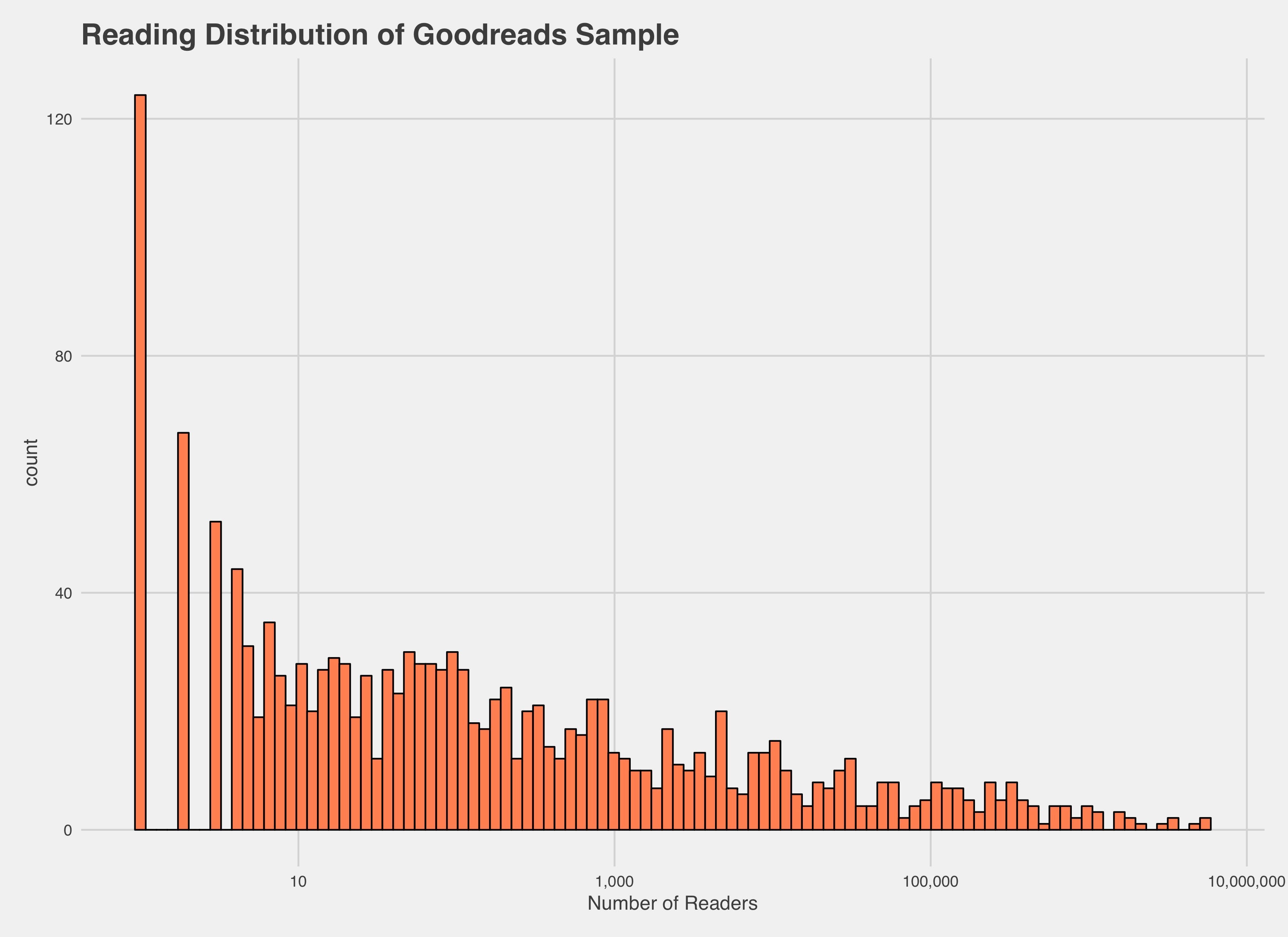
During the pandemic, I discovered Goodreads, the social book cataloguing website owned by Amazon. Much of the data that I was manually tracking was available on Goodreads, plus much more. Goodreads makes available the number of users who have added a book, plus the number that have marked it as read, as well as allows the crowd sourcing of genres. Goodreads is also remarkably comprehensive — I’ve been able to find just about every book that I’ve read on the site. For maybe the first time in history, we can calculate the readership of each book. By randomly sampling the Goodreads database, I discovered that that distribution is incredibly skewed — the median book had had only 21 readers!!

A ton of books have exactly 0 readers on Goodreads — there’s a lot of self-published crap out there! These include such titles as “Jesus Christ — the Master Psychologist”, “James Earl Jones Stress Away Coloring Book: An Adult Coloring Book Based on The Life of James Earl Jones”, “La bruja del amor y el yonqui del dinero”, “My Child Won’t Be Sh*t”, “Typewriter Hard Enamel Pin”, and the retrospectively ironic “What’s Freedom of the Press?” Even removing these 0 reader books, the median readership comes out to 65. Less surprisingly, the top bestsellers have had nearly 10 million people add them on Goodreads. A log scale is required to make the plot above human readable.

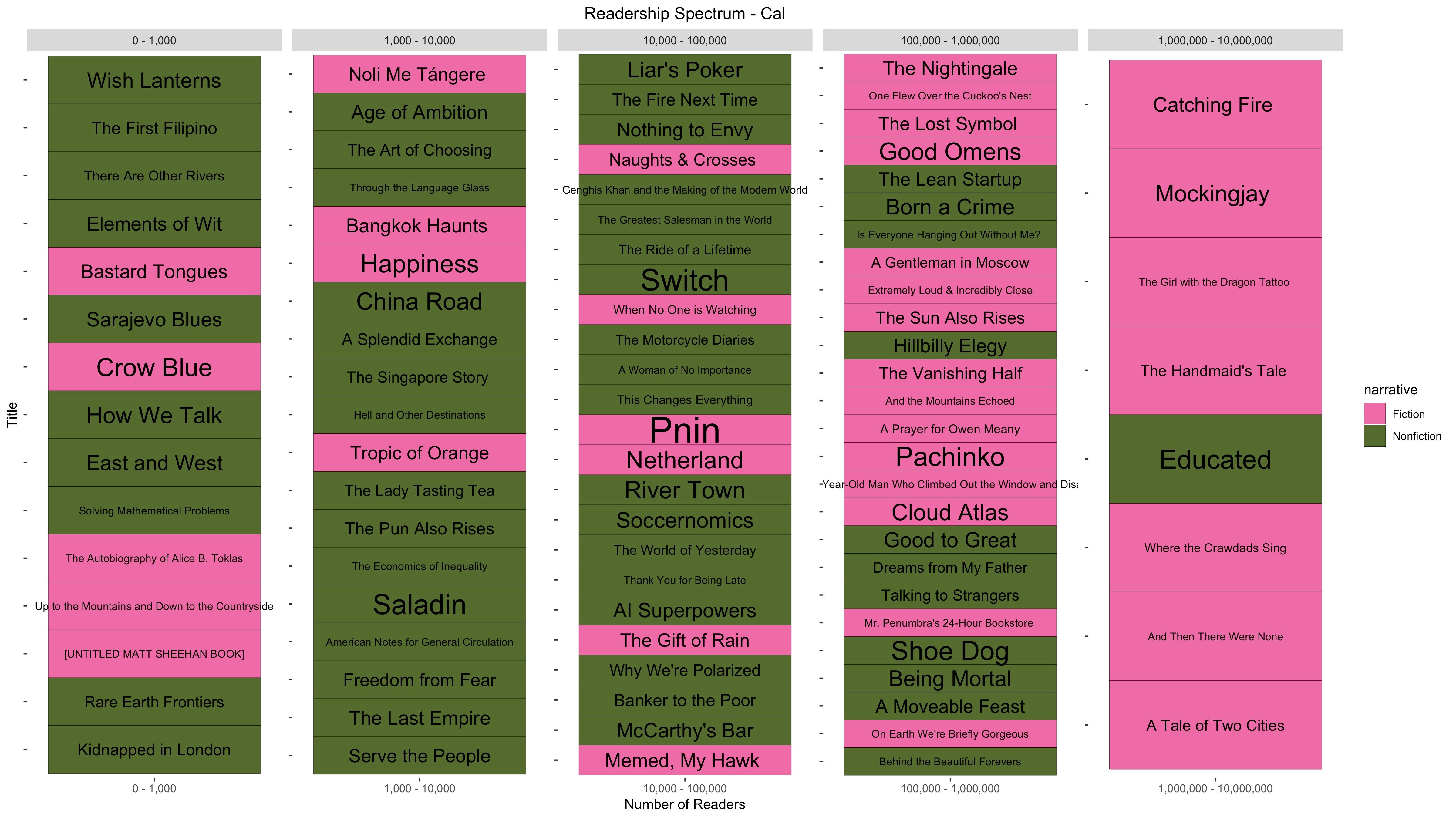
Nearly all of us will have a readership distribution extremely different from that graph. By definition, popular books are popular. Below I’ve plotted my books and sorted them in log 10 tiers.

Generally we find that the vast majority of popular books are fiction, but here I’d like to focus on the 0–1000 books. These are the obscure reads, the ones no one hears about from recommendation engines or book review articles. My discovering them are unique stories in their own right — many reflect my more esoteric interests. In fact, three of them were recommended from a single podcast called Sinica. A few highlights are below.

  • Wish Lanterns by Alec Ash (2017):
This book collates 9 lives of ordinary Chinese millennials, diving deep into their early adult lives. It gives personal stories that supplement the traditional narratives of China’s macro growth trends. Alec Ash was interviewed on Sinica and I figured it’d be a good read to further my understanding of China.
  • The First Filipino by Leon Guerrero (1962):
I’ve long been fascinated by the Filipino national hero Jose Rizal, mostly due to his polyglot and polymath abilities. Sharp readers will find his novel Noli Me Tángere also on that graph. This may be the authoritative biography, which credits him with creating the concept of a Filipino state.
  • Bastard Tongues by Derek Bickerton (2008):
I picked this up in a yard sale in DC in 2011. It’s about Creole languages around the world, and why so many of them are so similar. Bickerton rips to shred the prevailing theory, that these languages are similar due to contact, and proposes a new one that is still controversial in the academic community. His respect for Creole language speakers, many of who erroneously refer to their own speech as “broken”, is always apparent. This is an author I’d most like to grab a beer with.
  • East and West by Chris Patten (1998):
The memoir written by the last governor of Hong Kong shortly after Hong Kong was handed over has not aged particularly well, but that’s part of its value too. I learned that Hong Kong’s GDP was ¼ of all of China’s in 1997, and so many of Patten’s predictions have gone so wrong mainly because China has grown so rapidly.
  • The Autobiography of Alice B. Toklas by Gertrude Stein (1933):
I’ve also long been fascinated by the 1920’s expat scene in Paris, which Gertrude Stein herself coined the Lost Generation. The creativity and output from that group is legendary. I’d analogized that period to the expat community in Beijing in the early 2000s, and was both validated and miffed to hear others independently make the same comparison. From what I’d read about this generation (you’ll find The Sun Also Rises and A Moveable Feast up in that graph), I had high hopes for Stein, but I found her style impenetrable and the content quite dull. There are lots of mildly interesting anecdotes of famous artists like Picasso and Matisse, but I didn’t come out with any sense of who these people were. In fact, I left with the sense that maybe these people were famous because they were connected to other famous people.
  • Up to the Mountains and Down to the Countryside by Quincy Carroll (2015):
Quincy was two years ahead of me in high school, and so when I learned he had written a fiction book about living in China, I felt duty call. It happens to be one of the better books about China that I have read, encapsulating third tier city life and the expat experience in a way that non-fictions do not. He writes about language in a novel way, allowing spectrums of bilingual experience to become accessible to non-Chinese speakers. In addition to the subject matter that resonated hard with me, the writing quality equally reminded me of our shared English teachers.
  • The Transpacific Experiment by Matt Sheehan (2019):
This one shows up on the plot as [UNTITLED MATT SHEEHAN BOOK], which probably means the author needs a better publicist. In fact, Matt Sheehan is an ultimate player who lived in Xi’an and Beijing whom I played with and against on numerous occasions. An ultimate injury is the catalyst for this book, which forced him to pursue his China journalism career from Silicon Valley. Diving insightfully into China-US relations with regard to technology, academia and immigrant politics, Sheehan’s book even taught me to view my own family’s immigration story in a new light. He was also interviewed on Sinica about this book, which is deserving of a place in the shelf of anyone even casually interested in China. It is certainly deserving of a name.
  • Rare Earth Frontiers by Julie Klinger (2017):


    This was another deep, deep cut from the Sinica podcast. An academic text (I ordered it from the Cornell University Press), this book exemplifies the much misunderstood discipline of Geography. Klinger explores how rare earth (which is a misnomer) mining is more often influenced by domestic and international politics than by geological or economic factors. The regions where heavy, polluting mining is most exploited are typically borderlands far from the country’s metropoles, inhabited by minority ethnic groups.
  • American Notes for General Circulation by Charles Dickens (1842)
This is technically not under 1000 readers — somehow about 1300 people claim to have read this obscure travel journal of Dickens’ 1842 journey around the United States. It doesn’t make for light reading, but I sloshed through and found many gems ̶d̶e̶s̶c̶r̶i̶b̶i̶n̶g̶ judging cities that I know well — Boston, New York, DC, Cincinnati, St. Louis — but from a brand old historical perspective. Some quotes:

party feeling runs very high: the great constitutional feature of this institution being, that directly the acrimony of the last election is over, the acrimony of the next one begins;

— -

THE beautiful metropolis of America is by no means so clean a city as Boston, but many of its streets have the same characteristics; except that the houses are not quite so fresh-coloured, the sign- boards are not quite so gaudy, the gilded letters not quite so golden, the bricks not quite so red, the stone not quite so white, the blinds and area railings not quite so green, the knobs and plates upon the street doors not quite so bright and twinkling.

— -

Few people would live in Washington, I take it, who were not obliged to reside there;

— -

Pittsburg is like Birmingham in England; at least its townspeople say so. Setting aside the streets, the shops, the houses, waggons, factories, public buildings, and population, perhaps it may be.

My takeaway from all this is that popularity is not very well correlated with quality — most of these unknown books are awesome. A book’s popularity is likely more correlated with how well-connected the author is, how accessible its subject is, and how well it is publicized. Additionally, I will describe at the end of this post some less obscure books that gave me great joy.

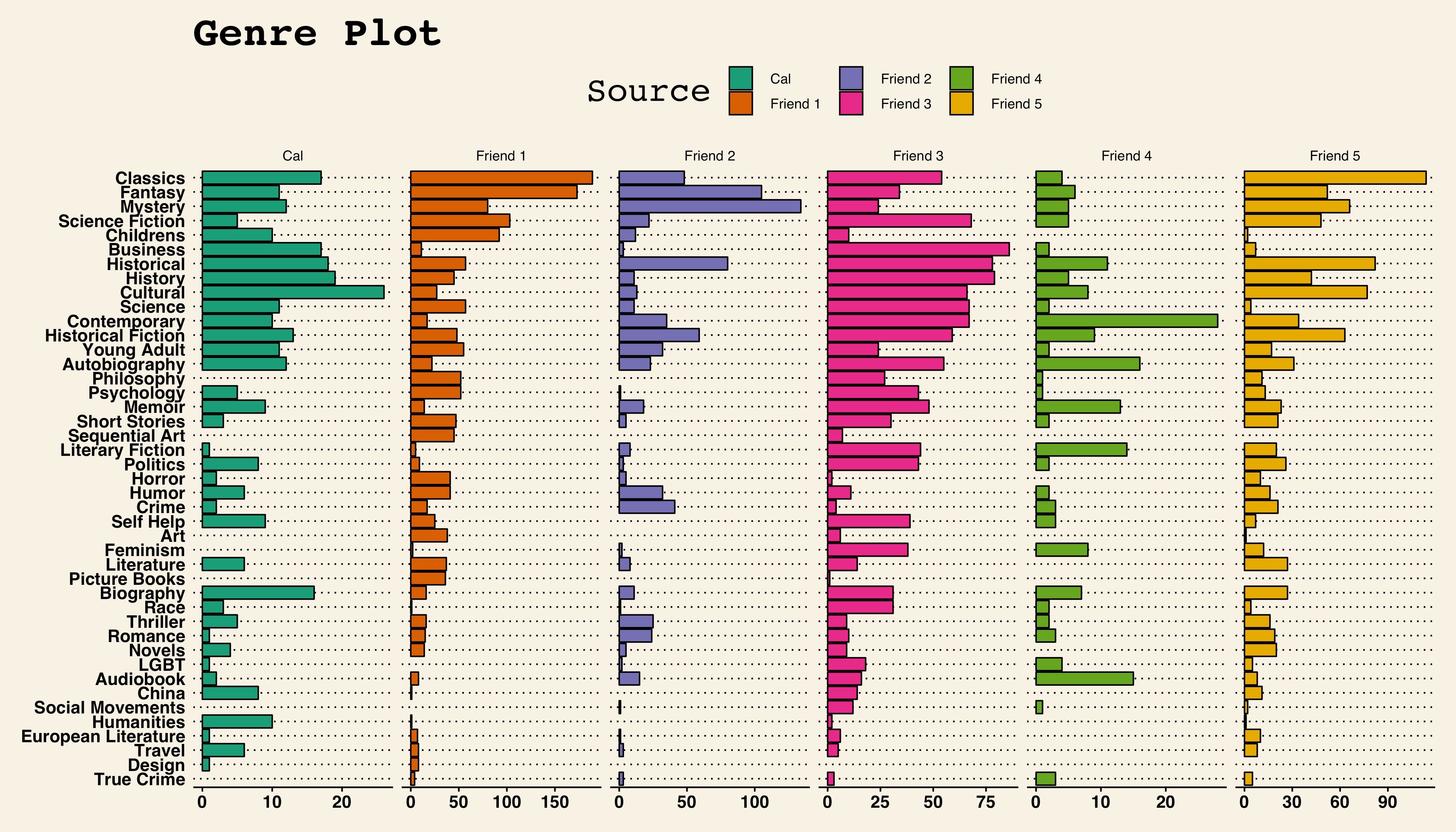
Goodreads allows you to export your books data, which includes useless information such as the binding and condition description, and does not include the crowd sourced shelf genres and number of total readers. Though Goodreads has also disappointingly disabled their developer API, I wrote code to scrape this information. I began soliciting friends to send me their exports, allowing the generation of plots like this one below.

Plotting out the distribution of read genres among multiple individuals taught me a lot about what I’m reading, what my friends are reading, and what we are not reading. Most conspicuous for me are the genres that are blank — Philosophy, Sequential Art (Graphic novels or comic books), Art, Feminism, Picture Books, Social Movements and True Crime. If you had straight up asked me, “Cal, do you read books about art?” I would have known no, I do not. But had I not seen this, I would not even have considered reading books about art to be a thing. To me, this is the real value of a crowd-sourced database like Goodreads, but not the direction that Amazon has been taking it. While it is primarily used to recommend new books similar to what you have enjoyed before, it can be used to show areas of literature that have been completely outside your purview.

Additional books I love:

  • The World of Yesterday by Stefan Zweig (1942):

I was on vacation in Salzburg when I walked down a street named Stefan Zweig Way. Who is this person worth naming a street over I asked Wikipedia. It’s a rare person whose life is of such acclaim that a Wikipedia article written 70 years after their death makes clear their works are worth reading. I picked up his final book and couldn’t put it down. Written in 1942, the book is half memoir, half history as Zweig recounts the final decades of the Austria-Hungarian empire, World War I and the rise of Hitler through his eyes as a Jew born in Vienna. Multilingual and famous in his time, Zweig lived all over Europe and embodied a cosmopolitan, passport-less Europe that vanished in his lifetime. Chock-full of great anecdotes, Zweig’s writing is incredible even in translation. The sadness he feels over this loss is present throughout the narrative. With his partner, he fled Europe, eventually ending up in Petropolis, Brazil, where they finished this manuscript, sent it off to the publishers, then committed suicide the next day via barbiturates.

  • Why We’re Polarized by Ezra Klein (2019):

Recommended by Amazon via their Great on Kindle program, this book has fundamentally changed the way I absorb news. Vox founder Ezra Klein persuasively demonstrates that our politics has become far more polarized throughout the past decade, why this was useful but is dangerous, and why our media consumption has created a feedback loop that demands more polarized media. Even though I have lived through much of the period of polarization, I hadn’t quite realized how many assumptions have fundamentally changed, as we have mainly gone from a society where our views dictated our political affiliation, to one where our political affiliation dictates our views. Serotonin and social media have allowed us to selectively choose stories with positive news about people we like and negative news about people we hate, leading to a population with polarized views of the truth. Of all the books I’ve listed so far, this is the most must-read of them all.

  • Happiness by Aminatta Forna:

I read this book as part of a Georgetown Alumni book club. Forna, who is Scottish and Sierra Leonean, is currently a visiting Professor at Georgetown. While reading this novel, I couldn’t believe the degree of difficulty it must’ve taken to write it —while setting a love story and family drama amidst the backdrop of West African immigrant life in London, Forna had to become an expert researcher in coyotes, foxes and trauma psychiatry. Quotes include this one introducing a main character:

‘Your parents named you after Attila the Hun?’ Attila smiled. ‘Some people,’ he said, ‘name their baby girls Victoria.’

And hits hard with gems like this:

Suffering had become a spectacle that served not to warn of the vagaries of misfortune but to remind the audience, sitting in warmth and comfort, of their own good fortune.

— —

I’m looking to expand on this idea, to demonstrate how literary meta-awareness can help guide us as we navigate life. I’m looking for more “users” — people to voluntarily export their Goodreads data and tell me if/how they find these analyses useful. I’m also looking for collaborators, who see value in what I’ve done and can offer further direction.

For more graphs and code, my Github link is below: https://github.com/cal65/Reading-History/tree/master/Books